Author: Los Patos Barcelona

  • Sundays and Public Holidays: What Is Open in Barcelona

    Sundays and Public Holidays: What Is Open in Barcelona

    Catalonia keeps Sunday trading restricted, more than most of Spain. That surprises a lot of visitors used to Sundays being an ordinary shopping day. Here’s what’s actually open, and why.

    CataloniaCommerce lawSundays and holidays

    The short version

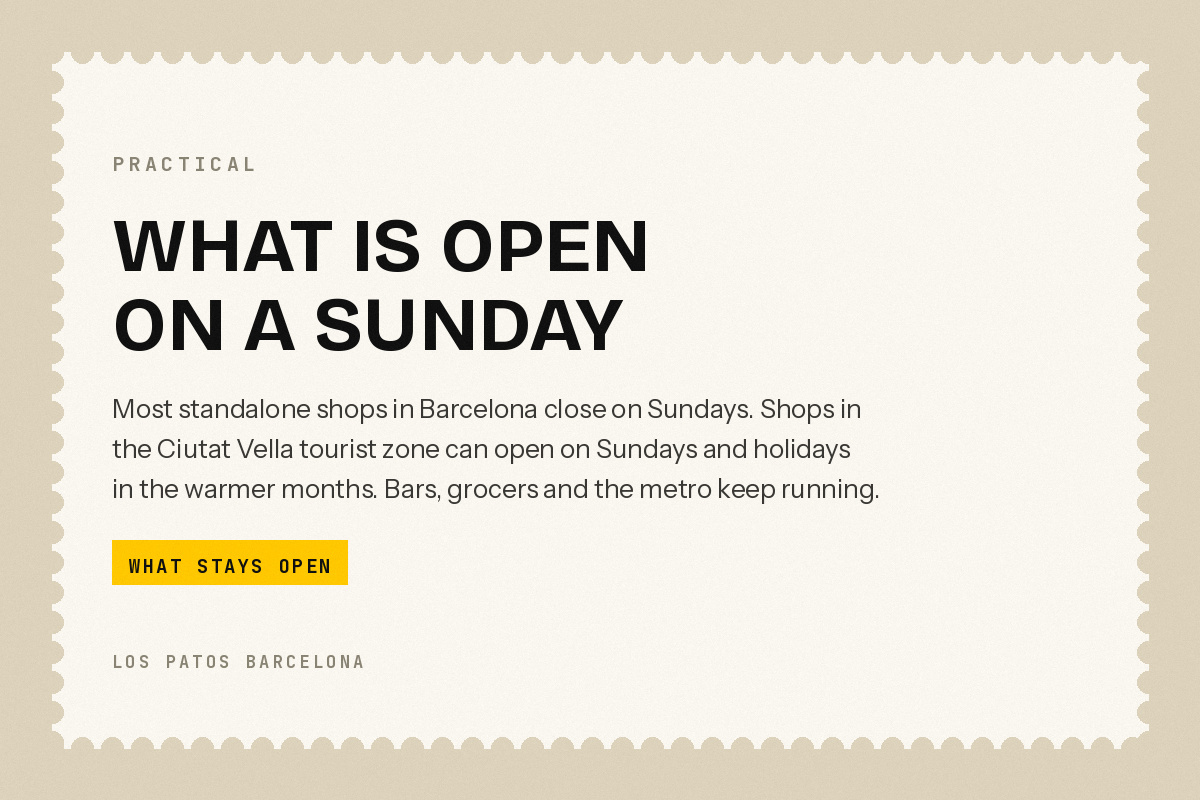
    Most standalone shops in Barcelona are closed on Sundays, for most of the year. Catalonia enforces Spain’s national Sunday closing rules more strictly than regions like Madrid, which allow shops in central tourist zones to open every day of the year. Barcelona’s version of that exception is narrower, and seasonal.

    The tourist zone exception

    Barcelona has a designated “high tourist influx” zone, largely covering Ciutat Vella (the Gothic Quarter, El Born, El Raval and Barceloneta). Shops inside that zone are allowed to open on Sundays and public holidays, roughly from midday to 8pm, during a defined summer stretch each year, plus a small number of extra authorised days scattered through the rest of the year, usually around the main holiday shopping periods. Outside that zone, or outside those dates, standalone shops stay closed.

    Worth knowing: if a public holiday happens to fall on a Sunday in Catalonia, the day off isn’t automatically moved to Monday, unlike in some other Spanish regions. The holiday is simply absorbed into the Sunday.

    What’s open regardless

    • Small corner grocery stores (often called “alimentación”), which are exempt from the general closing rule and commonly open seven days a week.
    • Restaurants and bars, which run on their own hours and aren’t affected by retail closing rules.
    • Large shopping centres with leisure and dining sections, such as Maremagnum in Port Vell, which tends to stay open on public holidays due to its location, with the main exception usually being 25 December.
    • Museums, most of which operate their own Sunday hours, and some of which offer free entry on specific Sundays or afternoons. Check the individual museum rather than assuming.
    • Public transport, which runs a full Sunday timetable, generally with reduced frequency compared to weekdays.

    What this means for planning

    If a Sunday or public holiday falls during a trip and shopping is part of the plan, Ciutat Vella is the safest bet for anything open outside of the big shopping centres, and it’s worth checking a specific shop’s hours rather than assuming city-wide rules apply evenly.

    Common questions

    Are shops open on Sundays in Barcelona?

    Most standalone shops are closed. Shops within the designated tourist zone (mainly Ciutat Vella) can open on Sundays and holidays during a set stretch of the warmer months, plus a handful of extra authorised days elsewhere in the year.

    Is Barcelona like Madrid for Sunday shopping?

    No. Madrid’s central tourist zone allows retailers to open every day of the year. Barcelona and the rest of Catalonia enforce the national Sunday restrictions more strictly, with a narrower, seasonal exception.

    Are supermarkets open on Sundays in Barcelona?

    Large supermarkets generally follow the same restrictions as other shops. Small independent grocery stores are usually the exception and tend to stay open daily.

    Does the Barcelona metro run on Sundays?

    Yes, on a full Sunday schedule, though typically with reduced frequency compared to weekdays.

    Know what’s open before you head out.

    We share free daily spots and what’s actually happening in Barcelona in the WhatsApp community, including on quieter Sundays.

    Join the community →
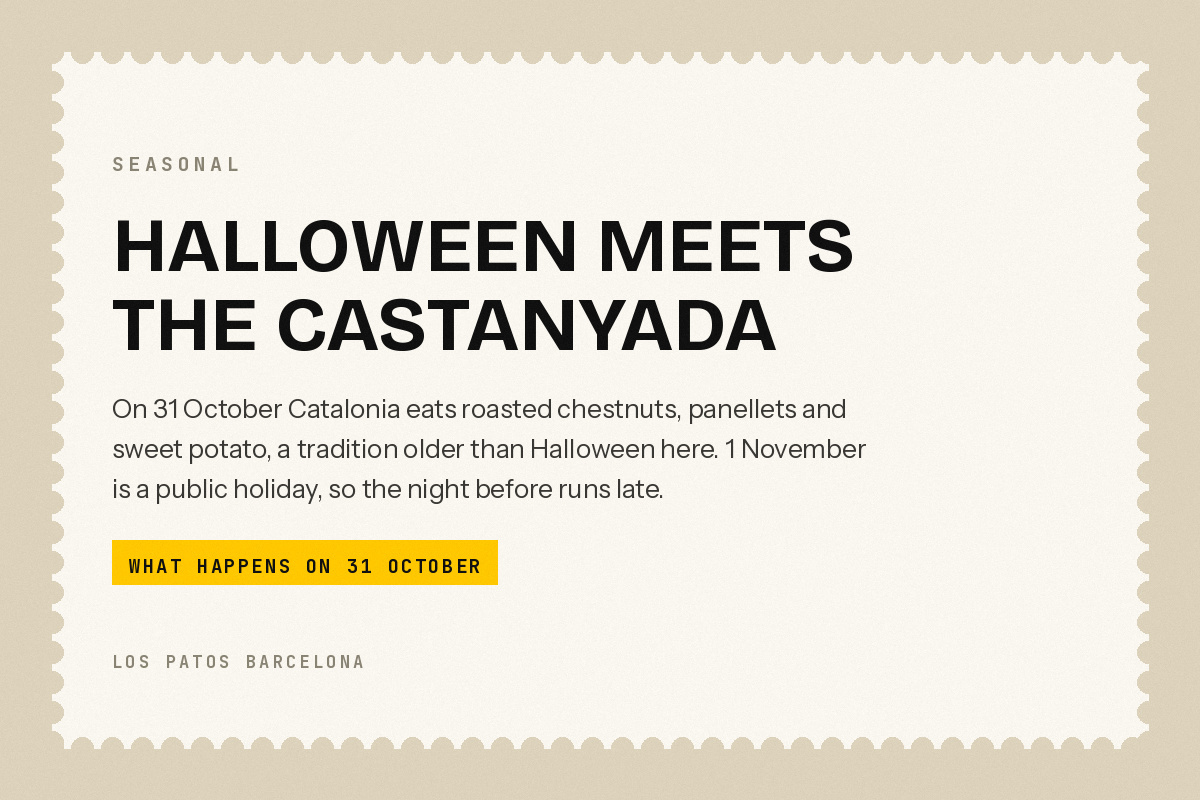
  • La Castanyada: What Catalonia Actually Does on 31 October

    Long before Halloween costumes reached Barcelona, Catalonia had its own way of marking the last night of October. It happens at home, around a table, and it smells of roast chestnuts.

    Catalonia31 October and 1 NovemberA family tradition

    What the Castanyada is

    The Castanyada takes its name from castanya, Catalan for chestnut. It is one of the most traditional celebrations in Catalonia and falls on the eve of All Saints’ Day, known in Catalan as Tots Sants, on 1 November. Families and friends gather to eat a short list of autumn foods that has stayed almost the same for generations.

    Tots Sants itself is a public holiday in Catalonia. On that day many families visit the cemetery to lay flowers for relatives who have died, and the Castanyada is the gentler, homely side of the same occasion: remembrance, followed by food shared together.

    What goes on the table

    • Roast chestnuts. Traditionally served hot in a paper cone. In autumn, street stalls selling them appear across the city.
    • Roast sweet potato. Known in Catalan as moniato, roasted whole alongside the chestnuts.
    • Panellets. Small sweets made from marzipan of ground almonds and sugar, bound with egg. The classic version is rolled in pine nuts, and it is by far the most popular. Other versions are coated in crushed almonds or coconut, and bakeries add new flavours every season.
    • Sweet muscat wine. A small glass of moscatell is the traditional drink to go with panellets.

    Panellets are found well beyond Barcelona: they are part of the season in Catalonia, Aragon, Valencia, the Balearic Islands and Andorra. Bakeries prepare them in large quantities in the days before 1 November.

    Worth knowing: the castanyera, an older woman in a headscarf and shawl roasting chestnuts over a small fire, is the figure most associated with the Castanyada. Children in Catalan schools still dress up as castanyeres around this date.

    Where it comes from

    The exact origin is uncertain, and several explanations exist side by side.

    The most popular one involves the bell ringers. On the night before All Saints, church bells rang for hours to call people to pray for the dead. The ringers needed a filling meal to get through the night, and chestnuts and sweet potatoes were cheap, warm and in season. Friends and family would join them, and the meal became a tradition of its own.

    Panellets have a related story. One theory links them to small bread offerings left for the dead, and by the early 19th century they were placed on graves for All Saints. Because they keep well for days, they suited a holiday built around remembrance. Their almond base has also led some historians to suggest roots in the cooking of Al-Andalus.

    The date of 1 November goes back to the 8th century, when Pope Gregory III dedicated a chapel in St Peter’s Basilica to all the saints. It may also overlap with older autumn festivals for the dead that existed across Europe.

    The Castanyada and Halloween today

    Halloween has become popular in Barcelona over recent decades, and today both celebrations share the same night. Some neighbourhoods even combine them, and you may see the word Castaween on local posters. For most Catalan families, though, the evening still revolves around chestnuts, panellets and time at home. We explain how the two traditions sit together in our guide to Halloween in Barcelona.

    How to join in as a visitor

    The easiest way is through food. Buy a paper cone of roast chestnuts from a street stall, then stop at a local bakery in the days before 1 November and choose a small mix of panellets. Pine nut is the classic, and trying two or three kinds side by side is the best way to understand why people care about them.

    On Tots Sants itself, opening hours across the city can change because it is a public holiday, so check ahead before planning a day of sightseeing.

    Common questions

    When is the Castanyada celebrated?

    On the evening of 31 October, the eve of All Saints’ Day (Tots Sants) on 1 November.

    What do people eat at the Castanyada?

    Roast chestnuts, roast sweet potatoes and panellets, the small almond marzipan sweets usually rolled in pine nuts, often with a glass of sweet muscat wine.

    What are panellets made of?

    Marzipan made from ground almonds and sugar, bound with egg. The classic version is coated in pine nuts; others use crushed almonds, coconut or newer flavours.

    Is 1 November a holiday in Barcelona?

    Yes. All Saints’ Day is a public holiday in Catalonia, and many families visit the cemetery that day to remember relatives.

    More of Barcelona’s culture, one story at a time.

    We share something worth knowing about Barcelona in the WhatsApp community most days, alongside the day’s plans around the city.

    Join the community →
  • Day Trips by Train from Barcelona

    Day Trips by Train from Barcelona

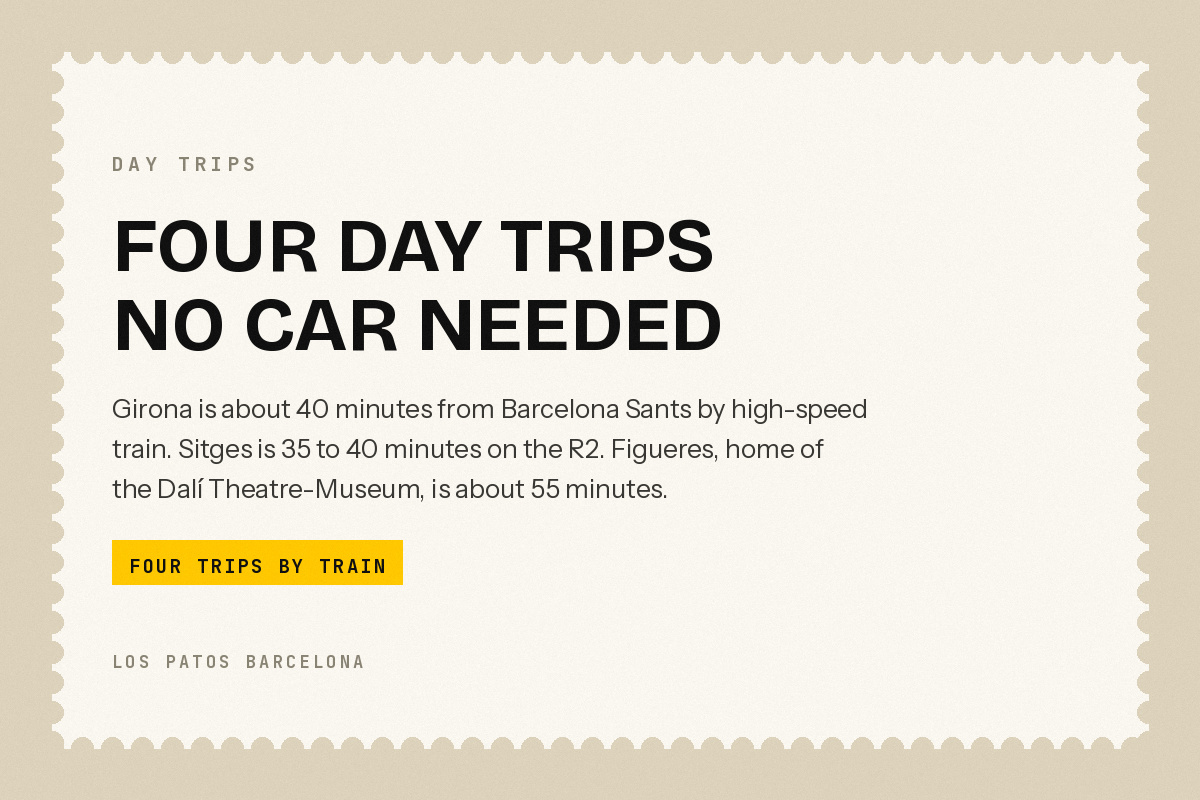
    Barcelona Sants sends trains out in enough directions that you don’t need a car for any of this. Four places, each under an hour and a half away, each a genuinely different day.

    By trainNo car neededUnder 90 minutes

    Girona

    From Barcelona Sants · around 40 minutes on the high-speed train

    A walled medieval city with Roman roots, cobbled streets, and a skyline dominated by its cathedral. One of the fastest and most complete day trips on this list, since almost everything worth seeing sits within walking distance of the old town.

    Sitges

    From Barcelona Sants · around 35 to 40 minutes on the R2 line

    A seaside town with a laid-back old centre and beaches that start a short walk from the station. Trains run frequently, roughly every 20 to 30 minutes, which makes it easy to show up without planning the return trip in advance.

    Montserrat

    From Plaça Espanya · around an hour, combining train and rack railway

    A mountain monastery an hour outside the city, reached by taking the FGC R5 line to Monistrol de Montserrat, then a cable car or rack railway up the mountain itself. The setting, jagged peaks with the monastery built into them, is the main event, with hiking trails for anyone who wants to stay longer than the main terrace.

    Figueres

    From Barcelona Sants · around 55 minutes on the high-speed train

    Salvador Dalí’s hometown, and the site of his Theatre-Museum, which he designed himself and which holds the largest collection of his work anywhere. A focused trip if the Dalí museum is the goal rather than general sightseeing.

    Quick comparison

    DestinationTravel timeBest for
    Girona~40 minMedieval streets, easiest full day
    Sitges~35-40 minBeach town, frequent trains
    Montserrat~1 hourMountains, hiking, the monastery
    Figueres~55 minDalí, a museum-focused day
    Worth knowing: Montserrat and Girona each take up most of a day once travel and walking are factored in. Sitges and Figueres are easier to pair with something else, or to do as a shorter half-day.

    Common questions

    Do I need to book train tickets in advance?

    Not for most regional lines, where tickets are bought at the station the same day. High-speed services can sell out on busy weekends, so booking a day or two ahead is a reasonable precaution rather than a requirement.

    Which day trip from Barcelona is easiest without a car?

    Sitges and Girona are the most straightforward, both reached directly from Barcelona Sants with no transfers.

    Can Montserrat be done in half a day?

    It’s possible, but tight once you factor in the train, the rack railway or cable car, and time at the top. A full day gives more room to actually enjoy it.

    Is Figueres only worth it for the Dalí museum?

    It’s the main draw, yes. If Dalí or surrealism isn’t a specific interest, Girona or Montserrat generally make for a more complete day.

    More of Barcelona, one story at a time.

    We share something worth knowing about Barcelona in the WhatsApp community most days, alongside the free daily spots worth checking out in the city itself.

    Join the community →
  • Halloween in Barcelona: Costumes, Chestnuts and the Castanyada

    Halloween in Barcelona: Costumes, Chestnuts and the Castanyada

    Halloween in Barcelona is two celebrations sharing one night. One is the costume party everyone knows. The other is the Castanyada, a Catalan autumn tradition that fills the streets with roasted chestnuts. Here’s what the night actually looks like.

    BarcelonaLate OctoberCostumes welcome

    The Castanyada, briefly

    Before Halloween arrived in Spain, the last night of October in Catalonia already had its own tradition. Street stalls roast castanyes (chestnuts) in paper cones, bakeries fill with panellets, small almond sweets rolled in pine nuts, and families share roasted moniato (sweet potato) at home. It happens on the eve of All Saints’ Day, which is a public holiday across Spain, so the whole city has reason to be out.

    Pick up a cone of chestnuts on the way to dinner and you’ve done the most Barcelona thing about the night before the costumes even come out.

    Halloween night out

    Halloween has grown into one of the biggest nights out of the autumn here. Bars and clubs run themed nights, most people make the effort to dress up, and because the next day is a holiday, the city doesn’t rush home early.

    Worth knowing: because 1 November is a public holiday, transport tends to run later than on an ordinary weeknight. Check the evening’s timetable before you head out so getting home isn’t the hard part.

    What to wear

    Any costume works, that’s the whole point of the night. If you want to match the name, a duck costume always gets a reaction.

    Stock changes every year, so here are search links rather than specific products, you’ll see what’s actually available when you click through.

    Whatever you wear, two things matter more than the costume itself. If it’s inflatable, it runs on a small battery-powered fan, check it takes batteries before the night rather than after. And if it covers your face, keep it easy to lift, doors check photo ID against your actual face.

    Common questions

    Is Halloween celebrated in Barcelona?

    Yes. It has grown into one of the biggest nights out of the autumn, with themed parties across the city’s bars and clubs. It shares the date with the Castanyada, a Catalan tradition that predates it here.

    What is the Castanyada?

    A Catalan celebration on the night of 31 October, the eve of All Saints’ Day. The food is roasted chestnuts, roasted sweet potato and panellets, small almond sweets rolled in pine nuts.

    Is 1 November a public holiday in Barcelona?

    Yes, All Saints’ Day is a national holiday in Spain, which is part of why the night before is such a big one for going out.

    Can I wear a full mask to a club on Halloween?

    You can wear a costume, but doors check ID against your face, so a mask that’s slow to remove will slow you down getting in. Keep it easy to lift.

    Our Halloween event

    On 31 October we run a hosted Halloween night: three events, club entry and Halloween accessories for the first 100 guests, with travellers from all over the world.

    Halloween with Los Patos Barcelona.

    Three hosted events, club entry with a drink and accessories for the first 100 guests, from 22:00 on 31 October.

    See the night and book →
  • Barcelona Neighbourhoods, by Day

    Barcelona Neighbourhoods, by Day

    Barcelona isn’t one city to walk through, it’s several, stitched together, each with a different pace during the day. Here’s what separates them before the sun goes down.

    BarcelonaDaytimeWalkable

    Gothic Quarter

    Barcelona’s medieval core, narrow enough that the sun barely reaches some streets at midday. Roman walls still show through in places, and the Barcelona Cathedral anchors the area. It’s the most touristed part of the city by day, which also means it’s the easiest to navigate on foot with no particular plan.

    El Born

    Next door to the Gothic Quarter but calmer, with boutique shops tucked into medieval buildings and the Basílica de Santa Maria del Mar as its centrepiece. The Picasso Museum sits on one of its streets. Good for a slower walk than the Gothic Quarter’s.

    El Raval

    The most mixed and least polished of the central neighbourhoods, home to MACBA (the contemporary art museum) and a genuinely international population. Rougher around the edges than its neighbours, and more interesting for it by day.

    Barceloneta

    The old fishing quarter, now the closest thing Barcelona has to a beach town built into the city grid. Narrow streets run in a grid pattern distinct from the rest of the city, and seafood restaurants line the edges closest to the water.

    Poble Sec

    Quieter, residential, and sitting right at the base of Montjuïc. A strong local food scene without the crowds of the centre, and the easiest starting point for walking up the hill.

    Gràcia

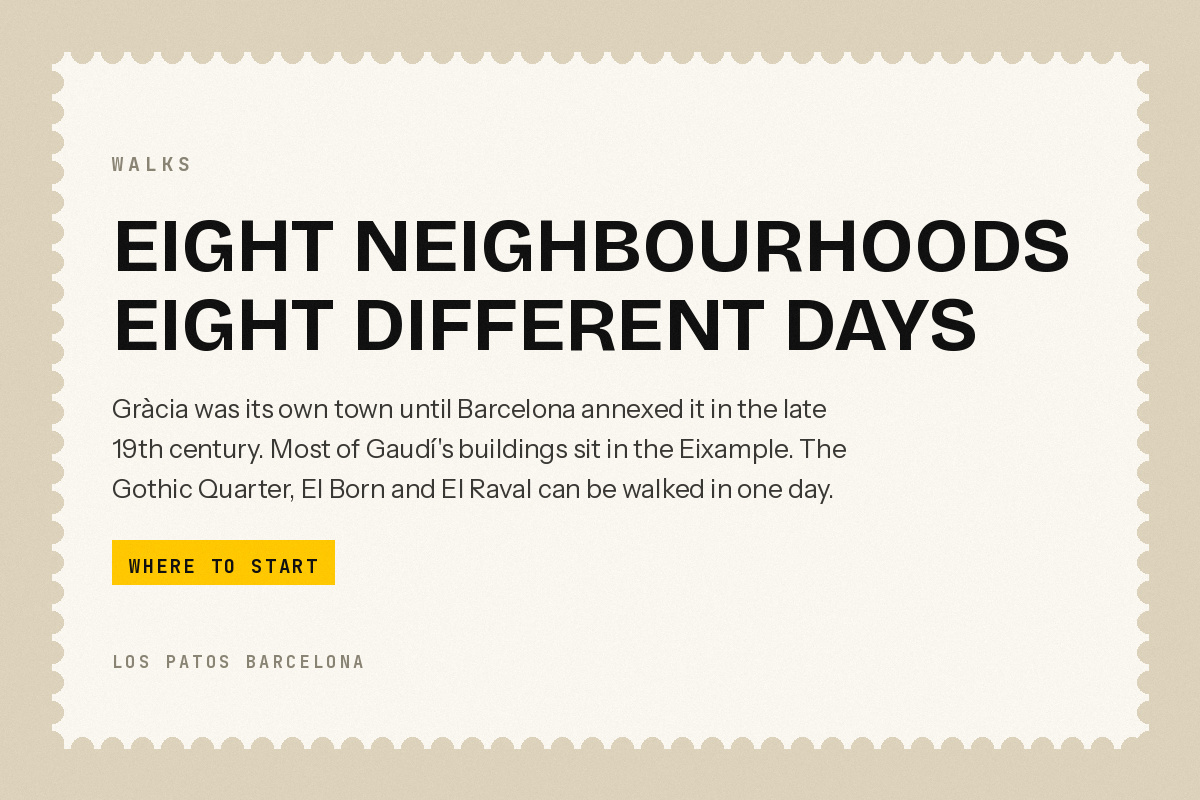
    Once its own separate town before Barcelona absorbed it, and it still feels that way. Small squares, independent shops, a village character that the more central neighbourhoods lost long ago.

    Eixample

    The grid. Planned in the 19th century with cut-corner blocks that are unmistakable from above, this is where most of the famous Gaudí buildings sit, spread out along wide, straight avenues.

    Poblenou

    Formerly an industrial district, now the most visibly transformed neighbourhood in the city, reshaped around the 1992 Olympics and still changing. Wide streets, converted factories, and a beach at the edge of it.

    Worth knowing: most of these sit close enough together that you can walk between two or three in a single day without needing transport, especially the Gothic Quarter, El Born and El Raval.

    Common questions

    Which Barcelona neighbourhood is best for walking?

    The Gothic Quarter, El Born and El Raval sit next to each other and are all genuinely walkable, with no need for transport between them.

    Is Barceloneta a separate town from Barcelona?

    No, it’s a neighbourhood within the city, though its grid layout and character are distinct from the surrounding areas.

    Was Gràcia always part of Barcelona?

    No, it was its own independent town until it was annexed by Barcelona in the late 19th century, which is part of why it still has a distinct village feel.

    Where are most of Gaudí’s buildings located?

    Mostly spread across the Eixample district, along its wide 19th-century avenues.

    A free spot, every day.

    We share a place worth checking out in the WhatsApp community most days, with a map pin and something worth knowing about it.

    See today’s tip →
  • Catalan in 12 Phrases

    Catalan in 12 Phrases

    Spanish gets you through Barcelona just fine. But Catalan is the language on the street signs, the one spoken in the markets, and the one that gets a genuine smile when a visitor makes the effort. Here are twelve phrases worth knowing.

    CataloniaRomance languageOfficial in Catalonia

    It’s not a dialect of Spanish

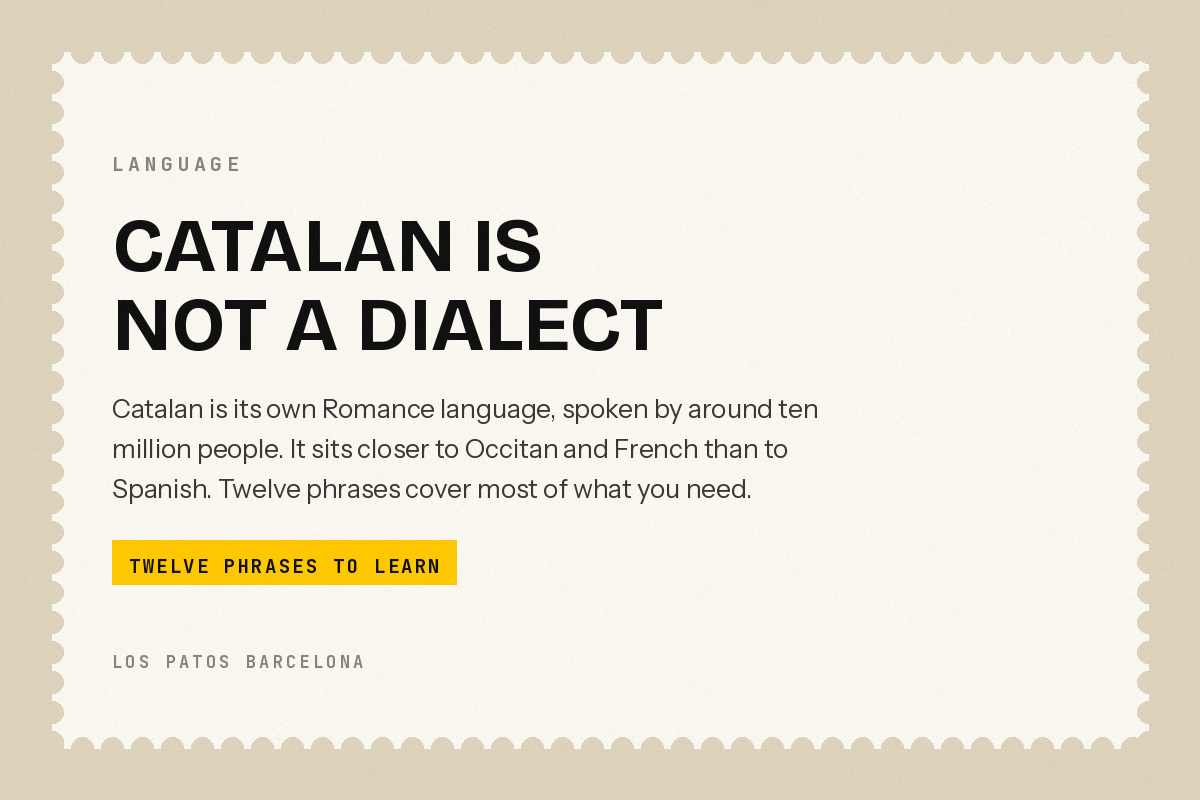
    Catalan is its own Romance language, not a variant of Spanish. It developed separately, shares more grammar with Occitan and French than with Castilian Spanish, and is spoken by roughly ten million people across Catalonia, Valencia, the Balearic Islands, and parts of France and Italy. In Catalonia it’s co-official alongside Spanish, and it’s what you’ll see on most street signs and menus.

    Twelve phrases to start with

    CatalanRough soundMeans
    Bon diabon DEE-ahGood morning
    Bona tardaBO-nah TAR-dahGood afternoon
    Bona nitBO-nah NEETGood night
    Si us plausee oos PLOWPlease
    GràciesGRAH-see-esThank you
    De resdeh RESSYou’re welcome
    Com estàs?com es-TAHSHow are you?
    Molt bémol BEHVery well
    On és…?on ESSWhere is…?
    Quant costa?kwan COS-tahHow much is it?
    No ho entencno oh en-TENKI don’t understand
    Salut!sah-LOOTCheers
    Worth knowing: the ny sound, as in “Catalunya,” is pronounced like the “ny” in “canyon.” It shows up constantly once you start listening for it.

    Where it actually helps

    Nobody expects fluency. But a “bon dia” at a bakery counter or a “gràcies” at the end of a transaction lands differently than the Spanish equivalent, because it signals you noticed where you are rather than treating every Spanish-speaking place as interchangeable. Market vendors, small family-run bars, and older residents tend to respond to it the most.

    You won’t offend anyone by sticking to Spanish, which almost everyone in Barcelona also speaks fluently. But the twelve phrases above cost nothing to learn and open doors that stay closed otherwise.

    Common questions

    Is Catalan a dialect of Spanish?

    No. Catalan is a separate Romance language with its own grammar and vocabulary, historically closer to Occitan and French than to Castilian Spanish.

    Do I need to speak Catalan to get by in Barcelona?

    No. Spanish is spoken fluently throughout the city, and English covers most tourist-facing situations. Catalan is a bonus, not a requirement.

    How many people speak Catalan?

    Roughly ten million people across Catalonia, the Valencian Community, the Balearic Islands, Andorra, and parts of France and Italy.

    Is Catalan the official language of Catalonia?

    Yes, co-official alongside Spanish, and used on most official signage, menus, and public transport announcements.

    More of Barcelona, one story at a time.

    We share something worth knowing about Barcelona in the WhatsApp community most days, alongside the free daily spots worth checking out.

    Join the community →
  • Castells: How Catalonia Builds Human Towers

    Castells: How Catalonia Builds Human Towers

    If you’re in Barcelona or anywhere in Catalonia during festival season and see a crowd gathered in a square, climb on something and look over their heads. There’s a real chance you’re about to watch a group of people build a tower out of themselves.

    CataloniaUNESCO Heritage since 2010Free to watch

    What a castell actually is

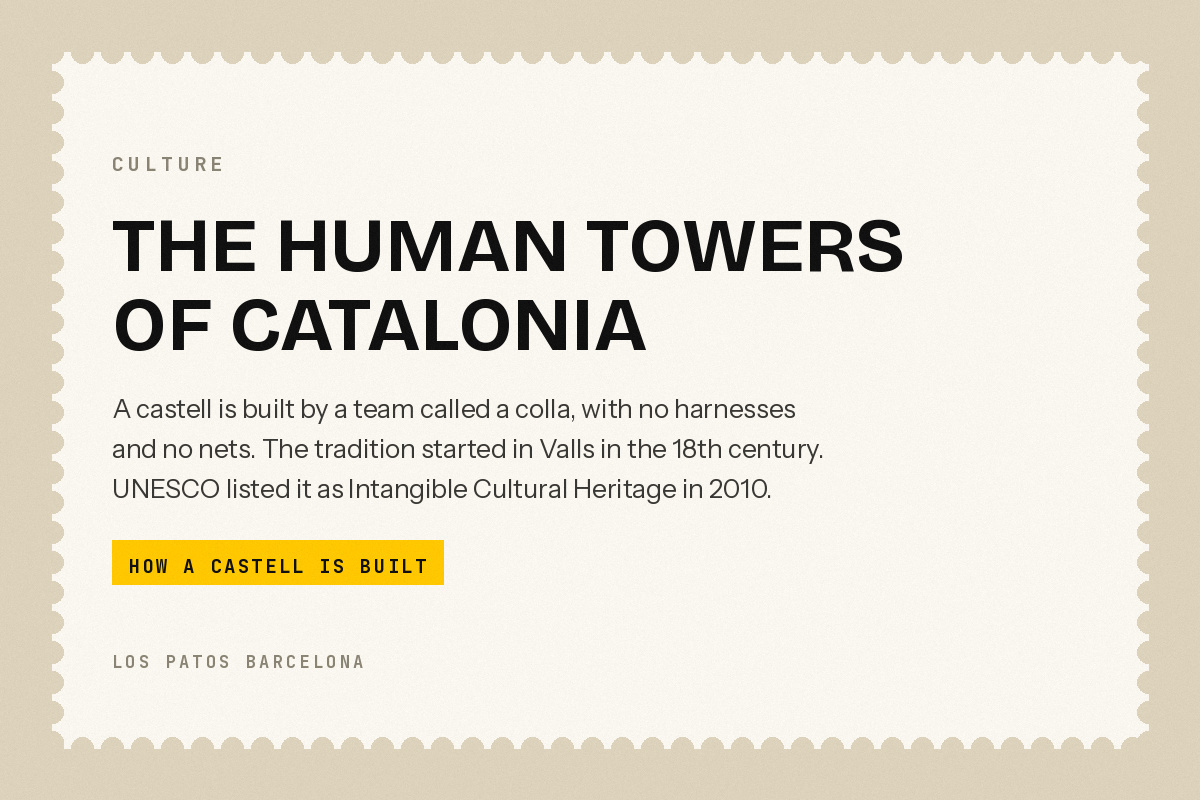
    A castell is a human tower, built by a team called a colla, with no harnesses, no nets, and no safety equipment beyond helmets for the children involved. The tradition started in the 18th century in Valls, a town near Tarragona, and grew out of a folk dance that used to end with people lifting each other into a small human figure. Over time the tower-building broke off and became its own thing.

    In 2010, UNESCO added castells to its list of Intangible Cultural Heritage of Humanity, recognising them as a living tradition rather than a historical curiosity.

    How a tower is actually built

    Every castell has three parts, and the names are worth knowing because you’ll hear them shouted across the square:

    • The pinya. A wide ring of people at the base, packed in tight. Their job is to hold everything above them steady, and to catch anyone who falls.
    • The tronc. Catalan for trunk, this is the tower itself, built level by level, with a set number of people standing on each other’s shoulders per level.
    • The pom de dalt. The top, usually three levels, climbed by the lightest and youngest members of the team, sometimes children as young as five or six. They’re the ones who get the applause when the tower is complete.

    Towers are named by how many people stand on each level and how many levels there are. A “4 de 9” means four people per level, nine levels high. The tallest ever recorded reached ten levels, first achieved in 1998.

    Worth knowing: a tower only counts as successfully built once it’s also been safely taken apart. Watching it come down, level by level, is as tense as watching it go up.

    Why it still matters

    Castells were never banned outright, even under Franco’s dictatorship, because at the time they weren’t seen as a political symbol, just a local tradition. That’s part of why the practice survived largely intact, and why today it’s one of the clearest living symbols of Catalan identity: open to anyone, built on trust in the people standing next to you, and passed down by people actually doing it rather than performing it.

    There are over 100 colles active across Catalonia today, and together they raise several thousand castells every year, mostly between the feast of Sant Joan in June and late October.

    Where to actually see one

    Castells show up at local festivals, known as festa major, across Catalan towns and villages throughout the warmer months. Barcelona itself has its own casteller groups and sees towers at major city festivals. If you’re planning around one specifically, check what’s on locally before you go, since dates and locations shift from town to town and year to year.

    Common questions

    Is building castells dangerous?

    There’s real risk and no harnesses are used, but the pinya exists specifically to catch falls, and children climbing the top levels wear helmets. Serious injuries are rare relative to how often towers are built.

    Where did castells originate?

    In Valls, a town near Tarragona, in the 18th century, growing out of a folk dance called the ball de valencians.

    When were castells declared UNESCO heritage?

    In 2010, when UNESCO added them to the Representative List of the Intangible Cultural Heritage of Humanity.

    Can anyone join a colla?

    Yes. Casteller teams are community groups, not professional performers, and most welcome new members regardless of age or experience. Climbing to the top is reserved for the lightest, usually children, but building the base is open to anyone with the willingness to stand in a very tightly packed crowd.

    What does “castell” mean?

    It’s Catalan for “castle.” The towers were named for their shape rather than any literal connection to a building.

    More of Barcelona’s culture, one story at a time.

    We share something worth knowing about Barcelona in the WhatsApp community most days, alongside the free daily spots worth checking out.

    Join the community →
  • How to Meet People in Barcelona When You Arrive Alone

    How to Meet People in Barcelona When You Arrive Alone

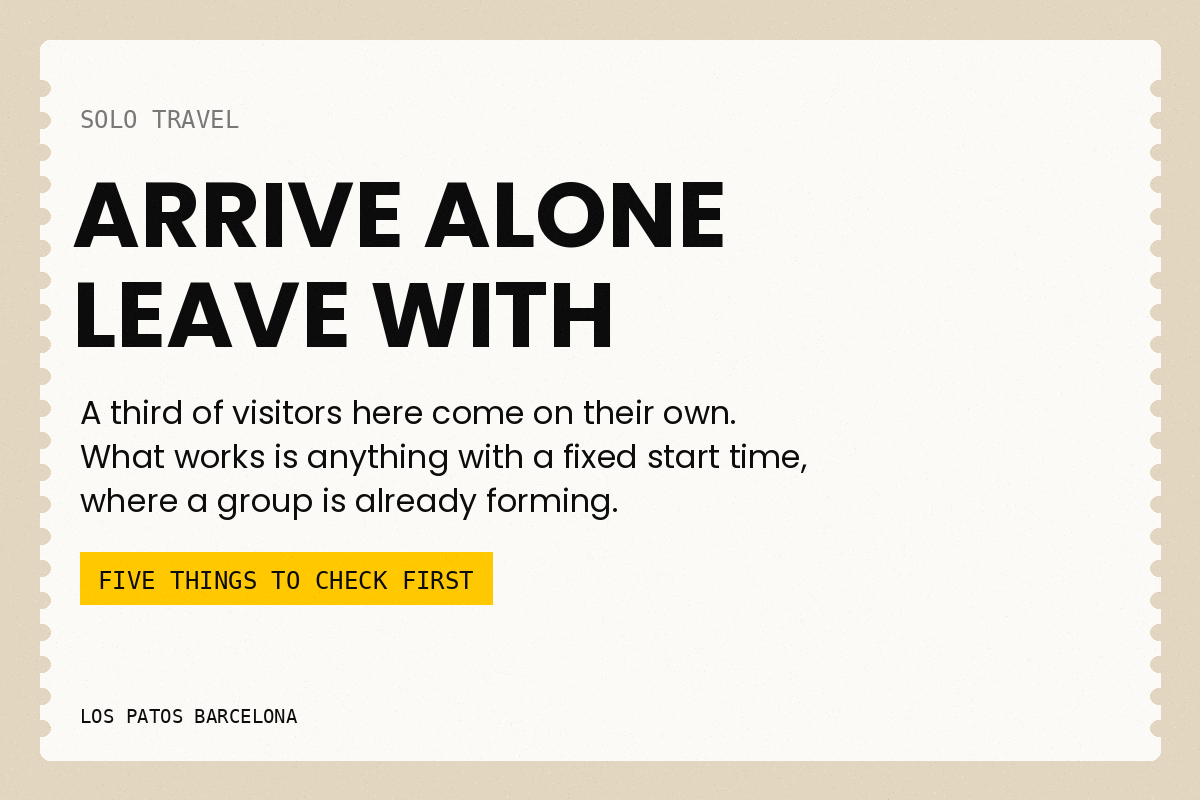
    A third of the people who visit Barcelona come on their own. Here is what works, and what to look for in a group night.

    BarcelonaSolo travelUpdated September 2026

    The hard part of arriving alone is the gap between dropping your bag and having a reason to leave the room. That gap easily turns into two days of walking around by yourself.

    Plenty of travellers feel it. In Barcelona, more than a third of visitors arrive alone and nearly half are here for the first time. Most of the people you will meet are in exactly the same position.

    What works, in order

    1. Anything with a fixed start time

    The single biggest factor is whether a group is already forming. A walking tour at 11:00 works because thirty people are standing in the same square at the same minute, most of them alone, and nobody has to introduce themselves. Conversations start because you are both looking at the same building.

    Contrast that with walking into a bar alone at 22:00 in a city where you do not speak the language. Very few people do it.

    2. Where you sleep, more than what you book

    A quiet apartment saves money and costs you the entire social side of the trip. A hostel with a common area and something on in the evenings does more for a solo trip than any activity you can pay for.

    3. Daytime before nighttime

    People are easier to talk to in daylight. Meet people at a free activity in the afternoon and you arrive at the evening already knowing someone, which changes the entire experience.

    4. Repeat, do not sample

    Going to one thing once rarely produces anything. Going to the same kind of thing three days in a row produces a group, because you start seeing the same faces.

    What to look for in a group night

    This applies to any organised activity in any city, and it is worth two minutes of your time.

    • A named host. A person who will be there on the night, named on the page.
    • Recent reviews. Fifteen reviews from last month tell you more than a hundred from two years ago.
    • A clear meeting point. A bar, a square or a landmark, published in advance.
    • Freedom to leave when you want. You decide how long you stay.
    • A plan for getting home. Barcelona’s metro runs all night on Saturdays and until around 02:00 on Fridays, but stops around midnight the rest of the week. Know your route or your budget for a taxi before you go out.
    A well-run activity answers all five clearly on its own page.

    Practical things that make it easier

    • Eat at the bar, not at a table. Bar seating in Spanish tapas places is designed for people eating alone. It is how a lot of locals eat.
    • Learn how to say your own name in a way people can repeat. Asking someone how to pronounce theirs is one of the easiest conversations there is.
    • Barcelona eats late. Dinner rarely before 21:00. If you turn up hungry at 19:00, you will be alone in a room full of other confused visitors.
    • Carry photo ID. Anything ending in a club needs it, and a photo on your phone does not count at the door.
    • Say yes on the first day. Starting early gives you more days with the people you meet.

    Common questions

    Is Barcelona good for solo travellers?

    Yes. It is compact, walkable, has a large hostel scene, and a high proportion of visitors who arrive alone.

    How do I meet people if I am shy?

    Choose things with a structure rather than open social situations. A walking tour, a class, a hosted event. With a structure, conversation starts on its own.

    Is it safe to go out at night alone in Barcelona?

    The centre is busy and lit until late. Plan your route home before you go out, as the metro stops around midnight on most weekdays.

    What is the best day to arrive?

    Any day works, but arriving earlier in the week gives you more chances to build a group before the weekend.

    How many days do you need to meet people?

    Two. Day one you meet people, day two those loose contacts turn into plans. Anything shorter and you are only sightseeing.

    Three hosted events every night, and you can leave whenever you want.

    Three venues, 45 minutes each, with a host waiting at every door. Come with friends or meet new ones. By the end of the night you know the group. Free cancellation up to 24 hours before.

    See tonight →
  • Barcelona by Season: What Actually Changes

    Barcelona by Season: What Actually Changes

    Same city, four different trips. What moves through the year, and how to choose when to come.

    BarcelonaPlanningUpdated September 2026

    Barcelona is good all year. What changes is the light, the crowd, the water temperature and what is open. Those four things decide what kind of trip you get.

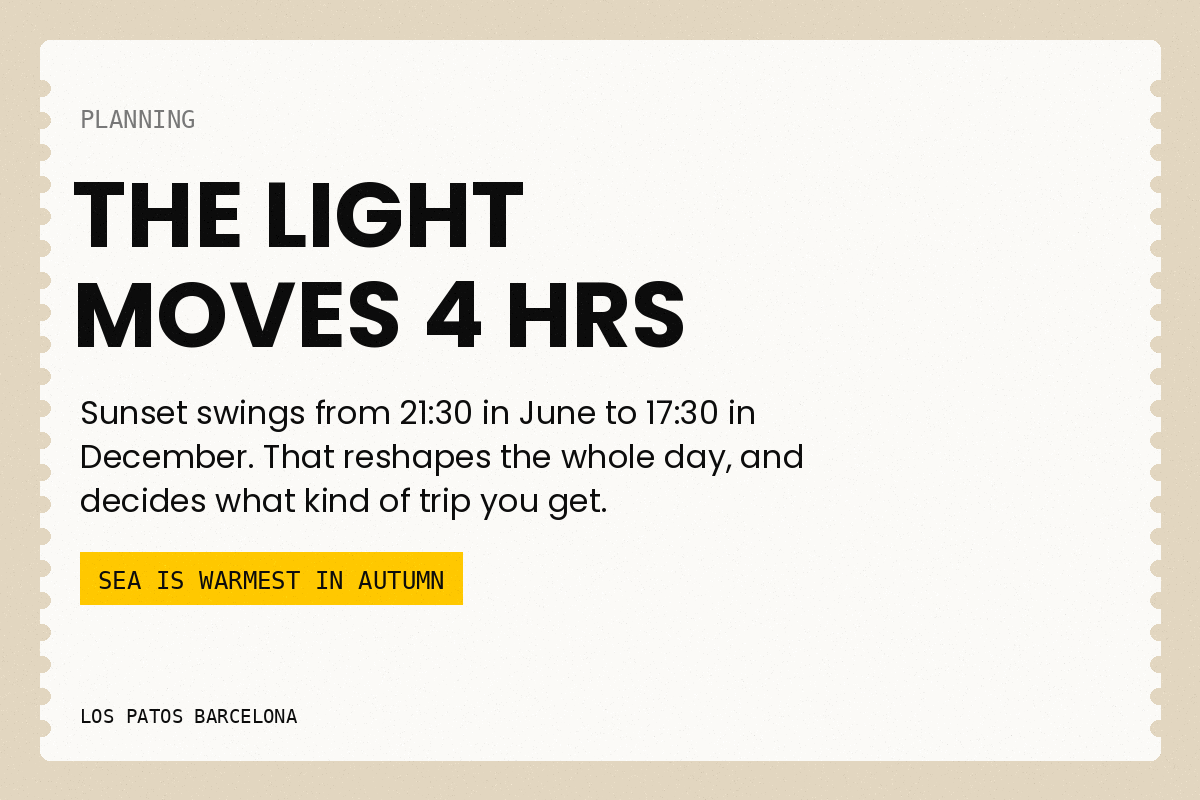
    The light moves four hours through the year

    Sunset in Barcelona swings from around 21:30 in June to around 17:30 in December. It reshapes the day.

    In summer you get a long warm evening and no rush. In winter it is dark before dinner, which means anything with a view has to happen in the afternoon, and the night starts earlier without feeling early.

    Whatever the month, the good light starts about forty minutes before the official sunset time. Arrive early to see all of it.

    Season by season

    Spring

    The most underrated stretch. Warm enough to be outside all day, cool enough to walk for hours, and the terraces fill up without the queues. The sea is still cold for swimming, so the beaches are for sitting rather than swimming.

    Best for: walking the city, day trips, anyone who dislikes crowds.

    Summer

    The busiest and hottest. Long evenings, everything open, and the highest prices and queues of the year. Midday in the old town is genuinely uncomfortable, and locals plan around it rather than through it.

    Best for: beaches, long nights, first-time visitors who want the postcard version.

    The catch: August is when much of the city leaves. Some neighbourhood restaurants close entirely for weeks.

    Early autumn

    The best time of year to come. The sea is at its warmest after a whole summer of heating up, the crowds thin out after August, and evenings are still long enough to sit outside. Prices come down from the summer peak.

    Best for: almost everything. Beach and city in the same trip.

    Late autumn and winter

    Quiet, cheap and cold enough that the day moves indoors. The city becomes local again. Some outdoor attractions reduce hours or close for maintenance, so check before you build a day around one.

    Best for: a city trip rather than a beach trip. Museums, food, neighbourhoods.

    What this means practically

    If you wantCome inBecause
    To swimEarly autumnWarmest sea of the year
    Long evenings outsideSummerSunset near 21:30
    To walk all daySpringWarm without the heat
    Low prices and spaceWinterOff season across the board
    Everything at onceEarly autumnThe overlap month

    Things that shift with the season

    • Outdoor attractions change their hours. Several reduce days or close entirely for maintenance in the coldest months. Always check the official site before travelling across the city for one.
    • The metro closes earlier than the nightlife, all year. It runs continuously on Saturday nights and a few public holiday eves, and until around 02:00 on Fridays. Other nights it stops well before clubs do.
    • Beach facilities are seasonal. Lifeguards, some chiringuitos and services run in the warm months. The sand is free and open all year.
    • Restaurant hours do not move. Lunch from about 13:30, dinner from about 21:00, in January the same as in July.
    • Festival season concentrates in summer and September. Expect all-night public transport on a handful of specific nights, and full accommodation around them.

    Common questions

    What is the best month to visit Barcelona?

    Early autumn, for most people. The sea is at its warmest, the summer crowds have thinned, and the evenings are still long. Spring is the alternative if you care more about walking than swimming.

    Is Barcelona worth visiting in winter?

    Yes, for a city trip. It is quiet, cheap and the city feels local again. It suits museums, food and neighbourhoods, and it gets dark before dinner.

    When is the sea warm enough to swim in Barcelona?

    The water is warmest at the end of summer, after months of heating up, rather than in the hottest air-temperature months.

    When is Barcelona least crowded?

    The coldest months, by a wide margin. After the summer peak is the best compromise between space and weather.

    Does anything close in August?

    Yes. Many small neighbourhood restaurants and businesses close for part of August while the city empties out. Tourist-facing places stay open.

    Something on every day, all year.

    Social experiences for travellers in Barcelona. The schedule shifts with the season, the city never stops.

    See this week →
  • Eating Near Las Ramblas Without Overpaying

    Eating Near Las Ramblas Without Overpaying

    The worst food in Barcelona and the highest prices are on the same 1.2 kilometres. Five minutes of walking fixes both. Here is exactly which way to walk and what to look for.

    BarcelonaFoodUpdated September 2026

    Las Ramblas is a good street to walk and an expensive one to eat on. The rent is the highest in the city, almost nobody eating there will ever come back, and both of those facts point restaurants in the same direction: charge more, care less. Two streets in any direction and the incentives flip completely.

    Five signals of a tourist-priced restaurant

    You can read a restaurant from the pavement in about three seconds. Any one of these is a warning. Two or more and keep walking.

    • Photographs of the food on the menu. The single most reliable signal in Europe. A kitchen that has to show you a picture is not confident you would order it from the name.
    • The menu in five or more languages, printed and laminated on a board outside.
    • Someone standing on the pavement inviting you in. If a place needs a person to fill its tables, the food is not doing that job.
    • Paella advertised on a picture board. Paella is Valencian, it takes real time to make, and it is not a Barcelona speciality. A paella permanently available with a photo next to it was frozen.
    • Sangria in a giant jug on the terrace. Locals drink it rarely. Order vermut instead, which is what people here drink before lunch.
    In short: a restaurant selling to people who will never return is priced and cooked for people who will never return.

    Where to walk instead

    West: El Raval

    Cross Las Ramblas heading west and you are in El Raval within a minute. It is the most mixed neighbourhood in the city, and the food follows: small Catalan bars, Pakistani and Filipino kitchens, and some of the cheapest good eating anywhere in the centre. Carrer d’en Robador and the streets around Rambla del Raval are the direction.

    East: the Gothic Quarter side streets

    Cross east and go deeper than the first two streets, which are still Ramblas prices with a different postcode. Aim for Plaça Reial and beyond, or the streets around Carrer dels Escudellers. The rule is the same as everywhere in the old town: the narrower the street and the fewer languages on the menu, the better you will eat.

    Further: Poble Sec and El Born

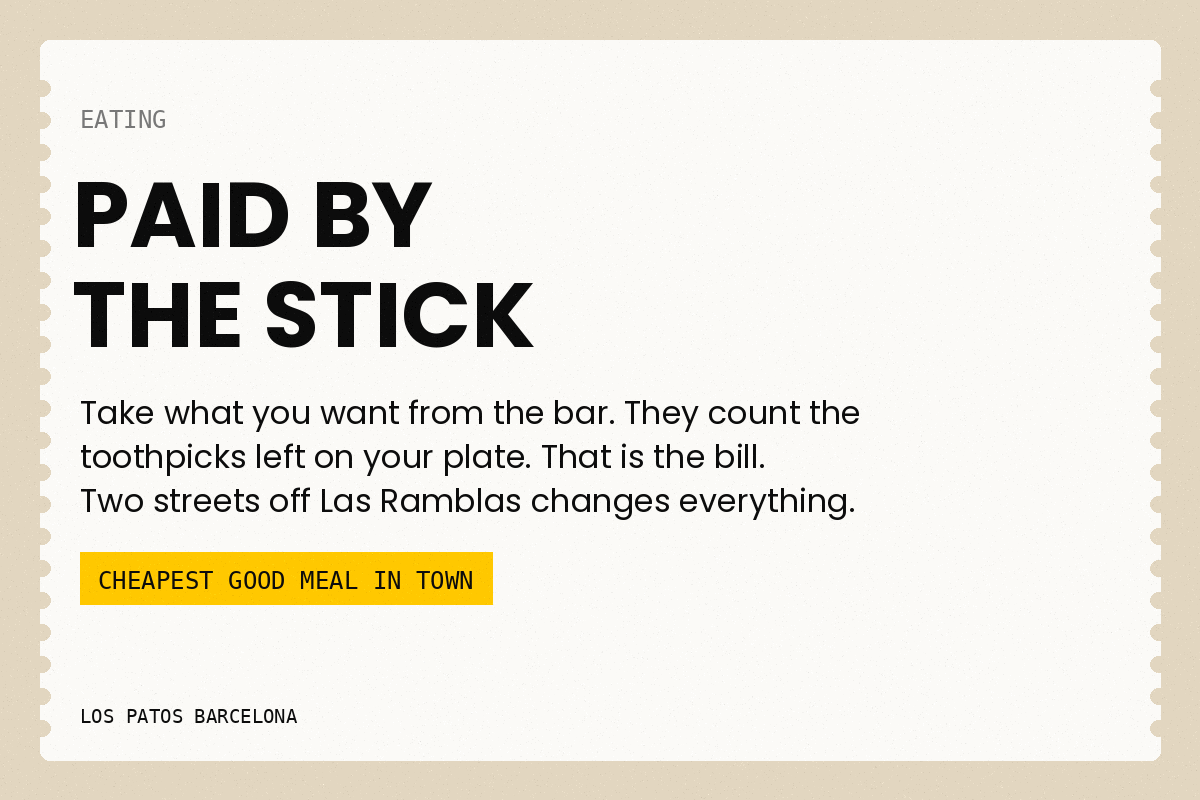
    Both are around fifteen minutes on foot and both are worth the walk for an evening rather than a quick lunch. Carrer de Blai in Poble Sec is a pedestrian street of pintxos bars where you take what you want from the counter and pay by the number of toothpicks left on your plate. It is the cheapest way to eat well in Barcelona and one of the most fun.

    The single biggest saving: menú del día

    On weekday middays, most neighbourhood restaurants serve a fixed price lunch menu: a starter, a main, bread, and a drink, sometimes dessert or coffee. It exists for people who work nearby, which is exactly why it is good and cheap.

    It is almost never advertised in English and often written on a chalkboard by the door. Look for the words menú del día or, in Catalan, menú del dia. Served roughly between 13:00 and 16:00, Monday to Friday.

    Eat at the local hours

    Barcelona eats late, and the hours decide your options.

    MealLocal hoursWhat happens if you go early
    Breakfast08:00 to 11:00Bakeries are open, restaurants are not
    Lunch13:30 to 16:00Before 13:00 the kitchen is not ready
    Dinner21:00 to 23:30Before 20:00 only tourist places are open

    If you turn up hungry at 19:00, the only places serving are the ones that exist for people who do not know the hours.

    What to order so you are not guessing

    • Pa amb tomàquet. Bread rubbed with tomato, oil and salt. The most Catalan thing on any menu and it comes with everything.
    • Bomba. A fried potato and meat ball with two sauces, invented in Barceloneta.
    • Escalivada. Roasted peppers, aubergine and onion. Reliably good and usually cheap.
    • Vermut. Sweet red vermouth with ice, an olive and an orange slice. Ordered before lunch, especially at the weekend.
    • Fideuà instead of paella. Same idea with short noodles instead of rice, more common here, and usually made properly.

    Breakfast, cheaply

    Skip the hotel and skip anything with a breakfast menu in English. Any neighbourhood bakery does a coffee and a pastry or a small bocadillo for a fraction of it, standing at the counter, in five minutes. This is how most of the city starts the day.

    One practical note about the street itself

    Las Ramblas is busy at every hour. Keep your bag zipped and your phone in your pocket, as you would on any crowded street.

    Common questions

    Is it a bad idea to eat on Las Ramblas?

    For a full meal, yes. The rent is the highest in the city and almost no customer returns, so prices are high and quality is low. Two streets in either direction the value changes completely.

    What is menú del día?

    A fixed price weekday lunch menu of two courses with bread and a drink, served in most neighbourhood restaurants between about 13:30 and 16:00. It is the best value meal in Spain and it is rarely advertised in English.

    What time do people eat dinner in Barcelona?

    From about 21:00, often later at weekends. Restaurants serving at 19:00 are usually aimed at visitors rather than locals.

    Where should I eat near Las Ramblas instead?

    El Raval to the west, the deeper Gothic Quarter streets to the east, and Carrer de Blai in Poble Sec for pintxos about fifteen minutes away.

    Should I order paella in Barcelona?

    Paella is Valencian rather than Catalan. If you want the local version of the same idea, order fideuà, which uses short noodles instead of rice. Avoid anywhere advertising paella with a photograph.

    The places we recommend.

    We keep a map of local picks around the city, food included, and share it free. The Free Walking Tour also runs daily at 11:00 from Plaça Catalunya, which is the fastest way to work out which neighbourhood you want to eat in.

    Join the WhatsApp group →