Category: Journal

Practical guides to Barcelona for travellers: neighbourhoods, viewpoints, beaches, food and going out.

  • How to Meet People in Barcelona When You Arrive Alone

    How to Meet People in Barcelona When You Arrive Alone

    A third of the people who visit Barcelona come on their own. Here is what actually works, and what to check before you go anywhere with strangers.

    BarcelonaSolo travelUpdated September 2026

    Arriving somewhere alone is not the hard part. The hard part is the gap between dropping your bag and having a reason to leave the room, and how easily that gap turns into two days of walking around by yourself.

    You are not unusual for feeling it. In Barcelona, more than a third of visitors arrive alone and nearly half are here for the first time. Most of the people you will meet are in exactly the same position.

    What actually works, in order

    1. Anything with a fixed start time

    The single biggest factor is not the activity, it is whether a group is already forming. A walking tour at 11:00 works because thirty people are standing in the same square at the same minute, most of them alone, and nobody has to introduce themselves. Conversations start because you are both looking at the same building.

    Contrast that with walking into a bar alone at 22:00 in a city where you do not speak the language. Almost nobody does it, and that is not a personal failing.

    2. Where you sleep, more than what you book

    A quiet apartment saves money and costs you the entire social side of the trip. A hostel with a common area and something on in the evenings does more for a solo trip than any activity you can pay for.

    3. Daytime before nighttime

    People are easier to talk to in daylight. Meet people at a free activity in the afternoon and you arrive at the evening already knowing someone, which changes the entire experience.

    4. Repeat, do not sample

    Going to one thing once rarely produces anything. Going to the same kind of thing three days in a row produces a group, because you start seeing the same faces.

    What to check before you go anywhere with strangers

    This applies to any organised activity in any city, and it is worth two minutes of your time.

    • Is there a named person responsible? Not a company name, a person who will be there. If nobody is accountable for the group, nobody is accountable for you.
    • Does it have real reviews, recently? A hundred reviews from two years ago tell you less than fifteen from last month.
    • Is the meeting point public and findable? A bar, a square, a landmark. If the location is only shared privately at the last minute with no context, that is worth questioning.
    • Can you leave whenever you want? The answer should be obviously yes, with no cost and no friction.
    • Do you know how you are getting home? Barcelona’s metro runs all night on Saturdays and until around 02:00 on Fridays, but stops around midnight the rest of the week. Know your route or your budget for a taxi before you go out, not at 03:00.
    If an activity cannot answer those five clearly on its own page, that is information. Good ones answer all five without being asked.

    Practical things that make it easier

    • Eat at the bar, not at a table. Bar seating in Spanish tapas places is designed for people eating alone. It is not a consolation prize, it is how a lot of locals eat.
    • Learn how to say your own name in a way people can repeat. Asking someone how to pronounce theirs is one of the easiest conversations there is.
    • Barcelona eats late. Dinner rarely before 21:00. If you turn up hungry at 19:00, you will be alone in a room full of other confused visitors.
    • Carry photo ID. Anything ending in a club needs it, and a photo on your phone does not count at the door.
    • Say yes on the first day. Not the second. Day two feels exactly like day one, except you have lost a day.

    Common questions

    Is Barcelona good for solo travellers?

    Yes. It is compact, walkable, has a large hostel scene, and a high proportion of visitors who arrive alone. The standard caution about pickpocketing in crowded areas applies, as it does in any major tourist city.

    How do I meet people if I am shy?

    Choose things with a structure rather than open social situations. A walking tour, a class, a hosted event. Structure removes the part where you have to approach strangers cold.

    Is it safe to go out at night alone in Barcelona?

    The centre is busy and lit until late, and violent crime against visitors is rare. The practical risks are pickpocketing and the metro closing. Going out with a group solves the second one and reduces the first.

    What is the best day to arrive?

    Any day works, but arriving earlier in the week gives you more chances to build a group before the weekend.

    How many days do you need to meet people?

    Two. Day one you meet people, day two those loose contacts turn into plans. Anything shorter and you are only sightseeing.

    Three hosted events every night, and you can leave whenever you want.

    Three venues, 45 minutes each, with a host waiting at every door. Most people arrive on their own. You do not stay that way. Free cancellation up to 24 hours before.

    See tonight →
  • Barcelona by Season: What Actually Changes

    Barcelona by Season: What Actually Changes

    Same city, four different trips. What moves through the year, and what most people get wrong about when to come.

    BarcelonaPlanningUpdated September 2026

    Most guides tell you Barcelona is good all year, which is true and useless. What actually changes is the light, the crowd, the water temperature and what is open. Those four things decide what kind of trip you get.

    The thing nobody mentions: the light moves four hours

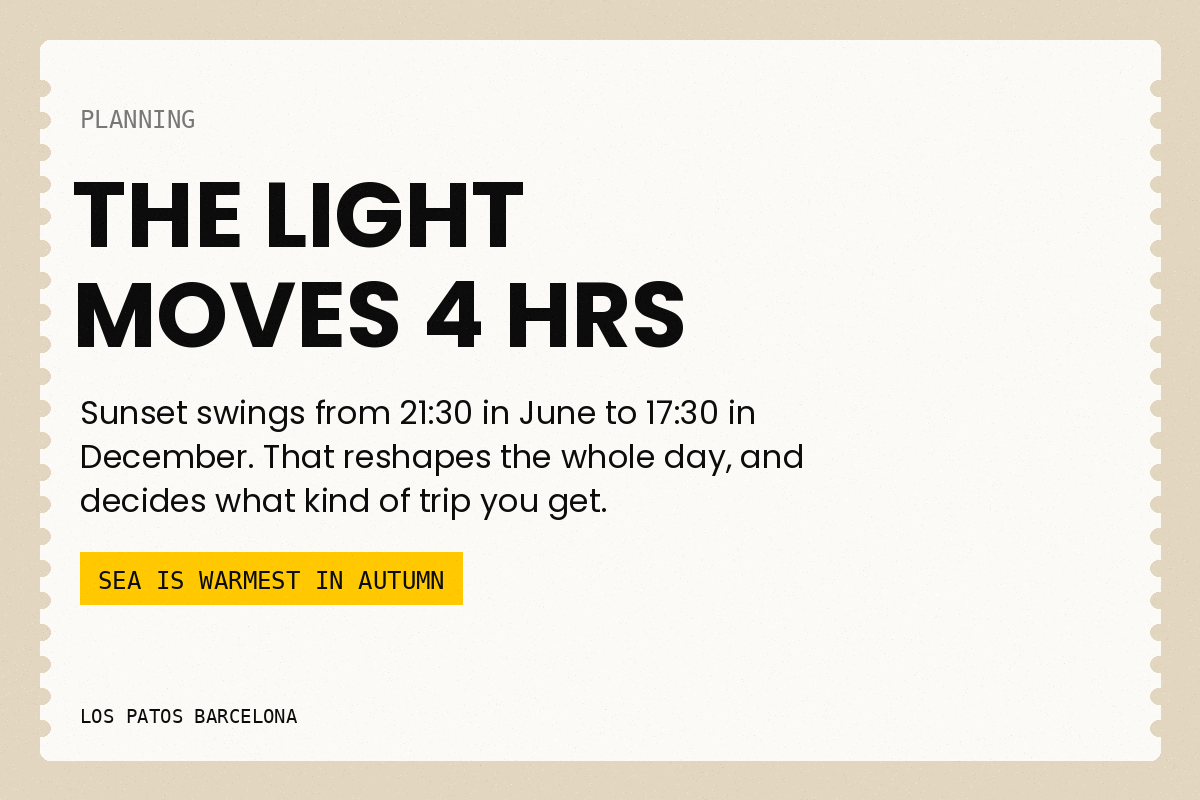
    Sunset in Barcelona swings from around 21:30 in June to around 17:30 in December. That is not a detail, it reshapes the day.

    In summer you get a long warm evening and no rush. In winter it is dark before dinner, which means anything with a view has to happen in the afternoon, and the night starts earlier without feeling early.

    Whatever the month, the good light starts about forty minutes before the official sunset time. Arriving at sunset means you missed most of it.

    Season by season

    Spring

    The most underrated stretch. Warm enough to be outside all day, cool enough to walk for hours, and the terraces fill up without the queues. The sea is still cold for swimming, so the beaches are for sitting rather than swimming.

    Best for: walking the city, day trips, anyone who dislikes crowds.

    Summer

    The busiest and hottest. Long evenings, everything open, and the highest prices and queues of the year. Midday in the old town is genuinely uncomfortable, and locals plan around it rather than through it.

    Best for: beaches, long nights, first-time visitors who want the postcard version.

    The catch: August is when much of the city leaves. Some neighbourhood restaurants close entirely for weeks.

    Early autumn

    The best month to come, and it is not close. The sea is at its warmest after a whole summer of heating up, the crowds thin out after August, and evenings are still long enough to sit outside. Prices come down from the summer peak.

    Best for: almost everything. Beach and city in the same trip.

    Late autumn and winter

    Quiet, cheap and cold enough that the day moves indoors. The city becomes local again. Some outdoor attractions reduce hours or close for maintenance, so check before you build a day around one.

    Best for: a city trip rather than a beach trip. Museums, food, neighbourhoods.

    What this means practically

    If you wantCome inBecause
    To swimEarly autumnWarmest sea of the year
    Long evenings outsideSummerSunset near 21:30
    To walk all daySpringWarm without the heat
    Low prices and spaceWinterOff season across the board
    Everything at onceEarly autumnThe overlap month

    Things that shift with the season and catch people out

    • Outdoor attractions change their hours. Several reduce days or close entirely for maintenance in the coldest months. Always check the official site before travelling across the city for one.
    • The metro closes earlier than the nightlife, all year. It runs continuously on Saturday nights and a few public holiday eves, and until around 02:00 on Fridays. Other nights it stops well before clubs do.
    • Beach facilities are seasonal. Lifeguards, some chiringuitos and services run in the warm months. The sand is free and open all year.
    • Restaurant hours do not move. Lunch from about 13:30, dinner from about 21:00, in January the same as in July.
    • Festival season concentrates in summer and September. Expect all-night public transport on a handful of specific nights, and full accommodation around them.

    Common questions

    What is the best month to visit Barcelona?

    Early autumn, for most people. The sea is at its warmest, the summer crowds have thinned, and the evenings are still long. Spring is the alternative if you care more about walking than swimming.

    Is Barcelona worth visiting in winter?

    Yes, for a city trip. It is quiet, cheap and the city feels local again. It is not a beach trip, and it gets dark before dinner.

    When is the sea warm enough to swim in Barcelona?

    The water is warmest at the end of summer, after months of heating up, rather than in the hottest air-temperature months.

    When is Barcelona least crowded?

    The coldest months, by a wide margin. After the summer peak is the best compromise between space and weather.

    Does anything close in August?

    Yes. Many small neighbourhood restaurants and businesses close for part of August while the city empties out. Tourist-facing places stay open.

    Something on every day, all year.

    Social experiences for travellers in Barcelona. The schedule shifts with the season, the city never stops.

    See this week →
  • Eating Near Las Ramblas Without Overpaying

    Eating Near Las Ramblas Without Overpaying

    The worst food in Barcelona and the highest prices are on the same 1.2 kilometres. Five minutes of walking fixes both. Here is exactly which way to walk and what to look for.

    BarcelonaFoodUpdated September 2026

    Las Ramblas is not a bad street. It is a bad street to eat on. The rent is the highest in the city, almost nobody eating there will ever come back, and both of those facts point restaurants in the same direction: charge more, care less. Two streets in any direction and the incentives flip completely.

    The five signals that a place is not for you

    You can read a restaurant from the pavement in about three seconds. Any one of these is a warning. Two or more and keep walking.

    • Photographs of the food on the menu. The single most reliable signal in Europe. A kitchen that has to show you a picture is not confident you would order it from the name.
    • The menu in five or more languages, printed and laminated on a board outside.
    • Someone standing on the pavement inviting you in. If a place needs a person to fill its tables, the food is not doing that job.
    • Paella advertised on a picture board. Paella is Valencian, it takes real time to make, and it is not a Barcelona speciality. A paella permanently available with a photo next to it was frozen.
    • Sangria in a giant jug on the terrace. Locals drink it rarely. It is a tourist signal, not a Catalan one. Order vermut instead, which is what people here actually drink before lunch.
    The one sentence version: if the restaurant is selling to people who will never return, it is priced and cooked for people who will never return.

    Where to walk instead

    West: El Raval

    Cross Las Ramblas heading west and you are in El Raval within a minute. It is the most mixed neighbourhood in the city, and the food follows: small Catalan bars, Pakistani and Filipino kitchens, and some of the cheapest good eating anywhere in the centre. Carrer d’en Robador and the streets around Rambla del Raval are the direction.

    East: the Gothic Quarter side streets

    Cross east and go deeper than the first two streets, which are still Ramblas prices with a different postcode. Aim for Plaça Reial and beyond, or the streets around Carrer dels Escudellers. The rule is the same as everywhere in the old town: the narrower the street and the fewer languages on the menu, the better you will eat.

    Further: Poble Sec and El Born

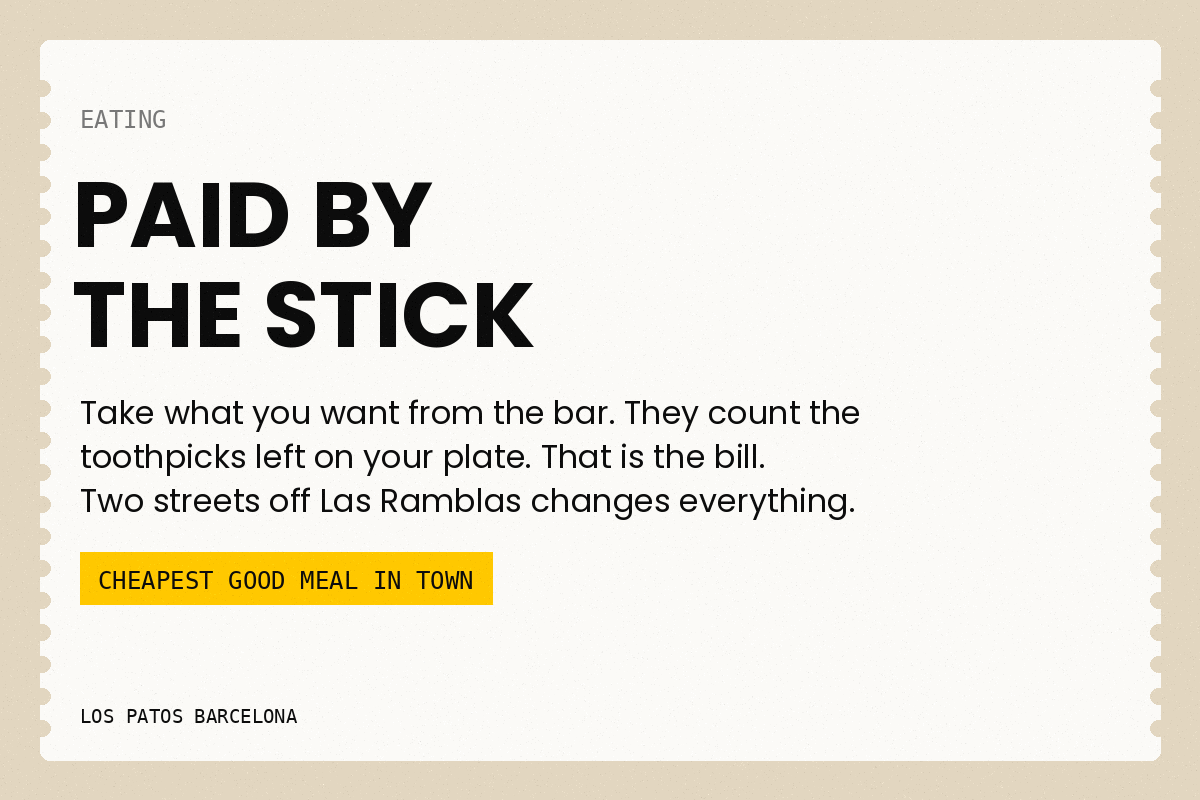
    Both are around fifteen minutes on foot and both are worth the walk for an evening rather than a quick lunch. Carrer de Blai in Poble Sec is a pedestrian street of pintxos bars where you take what you want from the counter and pay by the number of toothpicks left on your plate. It is the cheapest way to eat well in Barcelona and one of the most fun.

    The single biggest saving: menú del día

    On weekday middays, most neighbourhood restaurants serve a fixed price lunch menu: a starter, a main, bread, and a drink, sometimes dessert or coffee. It exists for people who work nearby, which is exactly why it is good and cheap.

    It is almost never advertised in English and often written on a chalkboard by the door. Look for the words menú del día or, in Catalan, menú del dia. Served roughly between 13:00 and 16:00, Monday to Friday.

    Eat at the right hours, or you have no options

    This is the mistake that sends more people back to Las Ramblas than any other. Barcelona eats late.

    MealLocal hoursWhat happens if you go early
    Breakfast08:00 to 11:00Bakeries are open, restaurants are not
    Lunch13:30 to 16:00Before 13:00 the kitchen is not ready
    Dinner21:00 to 23:30Before 20:00 only tourist places are open

    If you turn up hungry at 19:00, the only places serving are the ones that exist for people who do not know the hours. That is the trap, and it has nothing to do with your budget.

    What to order so you are not guessing

    • Pa amb tomàquet. Bread rubbed with tomato, oil and salt. The most Catalan thing on any menu and it comes with everything.
    • Bomba. A fried potato and meat ball with two sauces, invented in Barceloneta.
    • Escalivada. Roasted peppers, aubergine and onion. Reliably good and usually cheap.
    • Vermut. Sweet red vermouth with ice, an olive and an orange slice. Ordered before lunch, especially at the weekend.
    • Fideuà instead of paella. Same idea with short noodles instead of rice, more common here, and usually made properly.

    Breakfast, cheaply

    Skip the hotel and skip anything with a breakfast menu in English. Any neighbourhood bakery does a coffee and a pastry or a small bocadillo for a fraction of it, standing at the counter, in five minutes. This is how most of the city starts the day.

    One practical note about the street itself

    Las Ramblas is dense at every hour and it is the most worked pickpocketing ground in Barcelona. Bag zipped and in front of you, phone not left on an outdoor table. It is the same precaution you would take on any crowded tourist street anywhere, and it is not a reason to avoid the street.

    Common questions

    Is it a bad idea to eat on Las Ramblas?

    For a full meal, yes. The rent is the highest in the city and almost no customer returns, so prices are high and quality is low. Two streets in either direction the value changes completely.

    What is menú del día?

    A fixed price weekday lunch menu of two courses with bread and a drink, served in most neighbourhood restaurants between about 13:30 and 16:00. It is the best value meal in Spain and it is rarely advertised in English.

    What time do people eat dinner in Barcelona?

    From about 21:00, often later at weekends. Restaurants serving at 19:00 are usually aimed at visitors rather than locals.

    Where should I eat near Las Ramblas instead?

    El Raval to the west, the deeper Gothic Quarter streets to the east, and Carrer de Blai in Poble Sec for pintxos about fifteen minutes away.

    Should I order paella in Barcelona?

    Paella is Valencian rather than Catalan. If you want the local version of the same idea, order fideuà, which uses short noodles instead of rice. Avoid anywhere advertising paella with a photograph.

    The places we actually send people to.

    We keep a map of local picks around the city, food included, and share it free. The Free Walking Tour also runs daily at 11:00 from Plaça Catalunya, which is the fastest way to work out which neighbourhood you want to eat in.

    Get the local picks map →
  • Which Beach: Depending on What You Want From the Day

    Which Beach: Depending on What You Want From the Day

    Six beaches on one coastline, and they are not interchangeable. Which one to pick for space, for swimming, for volleyball, or for getting out of the city entirely.

    BarcelonaBeachesUpdated September 2026

    Barcelona’s city beaches run about four and a half kilometres in a near straight line from Barceloneta up to Llevant. They are all artificial, built for the 1992 Olympics on what had been industrial waterfront, and they are all free. Beyond that they differ more than the map suggests, and the difference is mostly about how far you are willing to walk from the metro.

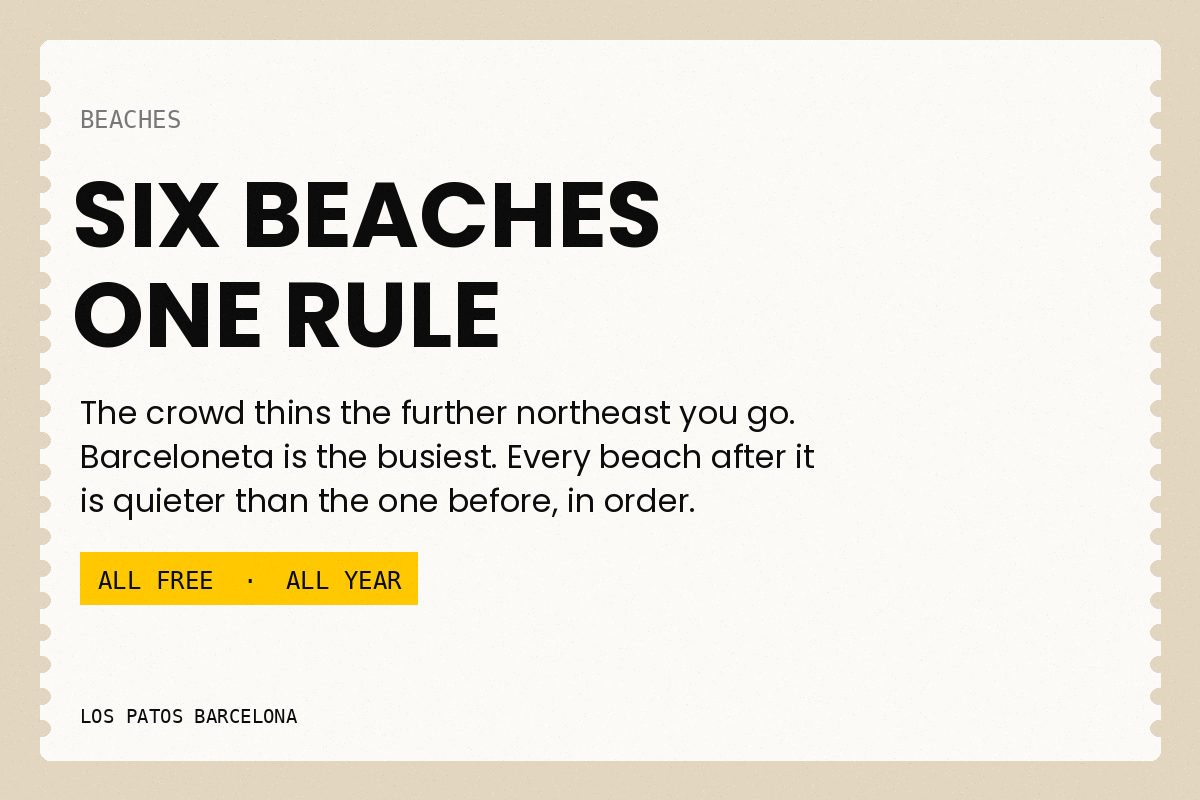
    The rule that explains all of it: the crowd thins the further northeast you go. Barceloneta is the closest to the old town and the busiest. Every beach after it is quieter than the one before, in order.

    Barceloneta

    Metro: Barceloneta (L4) · Walk from metro: 10 minutes · Free

    The famous one, the closest one, and the most crowded stretch of sand in the city between June and September. Everything is there: showers, toilets, lifeguards in season, bars along the whole front, and a promenade that never empties.

    Pick it if you have two hours and no patience for a journey, or you want the noise and the volleyball and the people.

    Skip it if you want to hear yourself think. Also the beach where pickpocketing is most common, so do not leave a bag while you swim.

    Sant Sebastià

    Metro: Barceloneta (L4) · Walk: 15 minutes southwest · Free

    The stretch southwest of Barceloneta, towards the W hotel. Same easy flat access, meaningfully more space, and you get Montjuïc rising behind you as the light goes in the evening.

    Pick it if you want Barceloneta’s convenience without Barceloneta’s density, or you are staying for the sunset.

    Bogatell

    Metro: Llacuna (L4) or Poblenou (L4) · Walk: 10 minutes · Free

    The one most people settle on once they have tried the others. Wider sand than Barceloneta, a much better ratio of people to square metre, volleyball courts that fill up in the late afternoon, and it is around thirty minutes on foot from Ciutat Vella if you would rather walk than take the metro.

    Pick it if you want the best all round balance of space, facilities and how long it takes to get there. If someone asks for one recommendation, this is it.

    Nova Icària

    Metro: Ciutadella Vila Olímpica (L4) · Walk: 10 minutes · Free

    Between Bogatell and the Olympic Port, and generally the calmest water of the city beaches, which makes it the one families and less confident swimmers gravitate to. Quieter in tone than its neighbours without being empty.

    Pick it if you actually want to swim rather than sit, or you want somewhere with less of a party atmosphere.

    Mar Bella

    Metro: Selva de Mar (L4) or Poblenou (L4) · Walk: 12 minutes · Free

    Further out again, and the most relaxed in feel. It has a designated nudist section, clearly signposted, which is worth knowing in advance rather than discovering. The clothed section either side is entirely normal. It is also Barcelona’s most established LGBTQ friendly beach.

    Pick it if you want space and a less touristy crowd, and you do not mind the extra ten minutes of travel.

    Llevant

    Metro: Selva de Mar (L4) · Walk: 15 minutes · Free

    The last city beach, the newest, and the emptiest. Fewer bars, fewer facilities, and correspondingly fewer people. There is a designated dog area, the only one on the city beaches.

    Pick it if you want quiet more than you want a beach bar within reach.

    Out of the city: Sitges

    Train: around 50 minutes from Barcelona Sants · Costs a train fare

    A proper town with seventeen beaches, a seafront church on a headland, and a completely different feel from the Barcelona waterfront. It is a day, not an afternoon: go in the morning, eat there, come back in the evening.

    Pick it if you have a full day and want to see something other than the city, or you want clearer water than the city beaches offer.

    Quick comparison

    BeachCrowdBest forMetro
    BarcelonetaVery busyConvenience, atmosphereBarceloneta
    Sant SebastiàBusySunset, more spaceBarceloneta
    BogatellModerateThe best all rounderLlacuna
    Nova IcàriaModerateSwimming, calmer waterCiutadella
    Mar BellaQuieterSpace, relaxed crowdSelva de Mar
    LlevantQuietestGetting away from itSelva de Mar
    SitgesIts own townA full day tripTrain from Sants

    Practical things worth knowing

    • Nothing on the sand is free. Sunbeds, parasols and the people selling drinks along the waterfront all cost, and none of it is necessary. Bring a towel and water.
    • Do not leave a bag unattended while you swim. This is the single most common way visitors lose a phone in Barcelona. Go in shifts, or take a waterproof pouch.
    • Check the flag. Green means fine, yellow means care, red means stay out. Red usually follows heavy rain, when runoff affects the water for a day or two.
    • Smoking is banned on the sand on every Barcelona beach and fines are handed out. You can smoke on the promenade and at the beach bar terraces, not on the beach itself.
    • Drinking alcohol in public on the beach is prohibited and can also be fined. A beer with food at a chiringuito is fine. A bottle on the sand is not.
    • Every city beach has free toilets, showers and lifeguards in season. What thins out as you go northeast is the number of bars, not the basics.
    • The season is longer than you think. The water is warmest in September, after a summer of heating up, and the beaches are far emptier than in August.
    • Sunday afternoons are the busiest. If you want space, go on a weekday morning.

    Common questions

    Which is the best beach in Barcelona?

    Bogatell, for most people. It has the best balance of space, facilities and travel time. Barceloneta is the most convenient and the most crowded.

    Are Barcelona beaches free?

    Yes, all of the city beaches are free to access. Only sunbeds, parasols and food cost anything.

    Which Barcelona beach is least crowded?

    Llevant, the furthest northeast of the city beaches. Mar Bella is the next quietest and has more facilities.

    Is there a nudist beach in Barcelona?

    Yes, Mar Bella has a designated and clearly signposted nudist section. The rest of the beach is clothed.

    When is the best month for the beach in Barcelona?

    September. The sea is at its warmest after the summer and the beaches are noticeably emptier than in July and August.

    A free spot a day, beaches included.

    We post one place a day in the WhatsApp community: a map pin, a suggested time, and something worth knowing about it before you go. All public, all free, none of it organised by us. React if you are heading over and other travellers might join you.

    See today’s tip →
  • Solo in Barcelona: The First 24 Hours

    Solo in Barcelona: The First 24 Hours

    Not a packing list. What happens hour by hour when you land here knowing nobody, including the parts nobody writes down.

    BarcelonaSolo travelUpdated September 2026

    The hard part of travelling alone is not the logistics. It is the gap between dropping your bag and having something to do that evening, and how easy it is to let that gap swallow the first two days. This is how to not lose them.

    Before you land: two things worth doing

    Pick where you sleep for the social side, not the price. A quiet apartment saves you money and costs you the whole reason you came. A hostel with a common area and something on in the evenings does more for a solo trip than any activity you book.

    Get a transport ticket sorted at the airport. Barcelona’s metro runs on multi journey cards you tap and pass between people. Buying one at the airport machine takes two minutes and saves you queueing at a machine every time you move.

    Hours 1 to 3: Arrival

    Drop your bag and go straight back out. Do not lie down, do not open the laptop. The first evening sets the pattern for the trip, and jet lag or nerves will talk you into staying in if you give them an hour to work.

    If you land in the morning, walk. If you land at night, the common area of wherever you are staying is enough. You do not need a plan yet.

    The one mistake almost everyone makes: waiting until day two to do anything social, on the theory that you will feel more settled. You will not. Day two feels exactly like day one, except now you have lost a day.

    Hour 4: The walking tour

    11:00 daily from Plaça Catalunya, a little over two hours. Two reasons it works as a first move, and only one of them is the history.

    The obvious one is orientation. You come out understanding how the Gothic Quarter, the Eixample and the waterfront relate to each other, which turns the rest of the week from wandering into navigating.

    The real one is that it is the lowest pressure way to talk to people that exists on a trip. Everyone is standing in the same place for two hours, most of them are alone, and nobody has to introduce themselves. Conversations start because you are both looking at the same building. By the end there is usually a group deciding where to get lunch.

    Hour 6: Lunch

    Barcelona eats late. Lunch runs from about 14:00, dinner rarely before 21:00. If you turn up at 19:00 expecting dinner, the only places open are the ones aimed at people who do not know that, which is also where the food is worst. There is more on that in eating near Las Ramblas without overpaying.

    Hour 9: Something free in the evening

    The gap between late afternoon and dinner is where solo trips go quiet. Fill it with something that costs nothing and has other people at it.

    Barcelona makes this easy: the Magic Fountain on Montjuïc, the park at Ciutadella, the view from Bunkers del Carmel, the tapas street in Poble Sec. All free, all public, all busy with people doing the same thing. Our WhatsApp community posts a different one most days with a time and a meeting point, and anyone can turn up. If you want a full list of the viewpoints, we ranked them by how far you have to walk.

    Hour 12 and after: Optional, not obligatory

    If the evening is still going and you want more, that is what the Social Access Pass is for: three hosted events in three venues, then club entry, every night. Go to one, go to all three, leave when you want.

    It is worth being clear about what it solves. Walking into a bar alone in a city where you do not speak the language is a specific kind of hard, and most people just do not do it. A hosted event removes that, because there is someone whose job is to introduce you and everyone there arrived on the same terms.

    What day one usually ends up looking like

    Most people finish day one having swapped numbers with at least one person from the walking tour or the evening event. That is the whole goal. Day two is when those loose contacts turn into actual plans, and from there the trip runs itself.

    If day one ends with nobody, it is not a verdict on you. It is a sample size of one. Repeat the same shape on day two and the odds change completely.

    We wrote a separate guide on how to meet people in Barcelona when you arrive alone, which goes deeper into what actually works and what to check before going anywhere with strangers.

    Practical things worth knowing

    • Pickpocketing is the real risk, not violence. Las Ramblas, the metro and the beach are where it happens. Bag zipped, in front of you, phone not on the table. That is the whole precaution.
    • Carry photo ID. Anything ending in a club needs it, and a photo on your phone does not count at the door.
    • The metro runs all night on Saturdays, until around 02:00 on Fridays and the eves of public holidays, and stops around midnight the rest of the week. Taxis from the centre are not expensive.
    • Barcelona is bilingual. Signs are in Catalan, everyone speaks Spanish, and English is fine in the centre. You do not need to worry about which to use.
    • Sunday afternoons are quiet. Many small places close. It is a good day for the beach or a hill, not for shopping.

    Common questions

    Is Barcelona safe for solo travellers?

    Yes, with the standard caveat about pickpocketing in crowded tourist areas. Violent crime against visitors is rare. The centre is busy and lit until late.

    Is it weird to eat alone in Barcelona?

    No. Bar seating in tapas places exists for exactly that, and plenty of locals eat standing at the bar on their own.

    What is the fastest way to meet people as a solo traveller?

    Anything with a fixed start time and a group already forming: a walking tour in the morning, a hosted evening event later. Both remove the part where you have to approach strangers cold.

    How many days do you need in Barcelona?

    Four gets you the city. Six or seven lets you add a beach day and a day trip without rushing.

    Do I need to speak Spanish?

    No. English works in the centre, in restaurants and on public transport. Learning to say please and thank you goes further than you would expect.

    The evening part, solved.

    Three hosted events in three venues, then club entry, every night of the week. You arrive alone, you do not stay that way. Free cancellation up to 24 hours before.

    See tonight →
  • Where to Watch the Sunset in Barcelona

    Where to Watch the Sunset in Barcelona

    Seven spots, ranked by how far you actually have to walk. What each one costs, when to arrive, and the catch nobody mentions.

    BarcelonaFree and paid optionsUpdated September 2026

    Barcelona faces southeast, which means the sun does not drop into the sea here the way it does on the Atlantic coast. It sets behind the hills, over the city. That changes what you are looking for: the best spots are the ones with the city itself in the frame, not an empty horizon.

    When the sun actually sets here

    This is the part most guides skip, and it is the one that ruins evenings. Sunset time in Barcelona moves by four hours across the year.

    • June and July: around 21:30. You have a long, warm evening and no rush.
    • April, May, August, September: roughly 20:00 to 21:00.
    • March and October: near 20:00 while the clocks are forward, then it jumps back an hour on the last Sunday of October.
    • November to January: around 17:30. It is dark before dinner.

    Two practical consequences. In winter, anywhere that closes at 17:30 is closed before the sun goes down. And the good light starts about forty minutes before the official time, so arriving at sunset means you missed most of it.

    Rule of thumb: arrive an hour early. The half hour after the sun disappears, when the sky goes pink then deep blue, is usually better than the sunset itself, and almost everyone leaves before it.

    Seven spots, easiest first

    1. Barceloneta beach

    Effort: none · Cost: free · Metro: Barceloneta (L4)

    Straight off the metro, flat the whole way. The lowest vantage point on this list, and the sun goes down behind the buildings rather than over anything scenic. What you get instead is the light on the water and the sky over the sea behind you.

    The catch: it is the busiest beach in the city and it stays busy. Fine if you want company, less good if you want quiet.

    2. Sant Sebastià beach

    Effort: a flat ten minute walk · Cost: free · Metro: Barceloneta (L4)

    Keep walking southwest along the boardwalk past Barceloneta and the crowd thins out fast. Same flat access, noticeably more space, and you get Montjuïc rising on your right as the light goes.

    The catch: fewer places open nearby once it gets dark.

    3. Jardins de Miramar, Montjuïc

    Effort: 10 to 15 minutes uphill · Cost: free · Metro: Paral·lel (L2, L3) then walk

    A terrace on the sea side of Montjuïc looking straight down over the port. Much less known than the castle above it, and free with no gate and no closing time.

    The catch: it faces the port, so you are watching the light rather than the sun itself.

    4. Montjuïc Castle walls

    Effort: about 20 minutes uphill from Poble Sec · Cost: free to walk up, cable car costs a fare

    The highest point on the southern side, with the sea on one flank and the whole city on the other. Walking up from Poble Sec takes around twenty minutes and saves the cable car fare. The outer walls and the surrounding park are open and free.

    The catch: the castle interior has opening hours and closes early in winter. The walk down in the dark is fine but poorly lit in places.

    5. Park Güell, free zone

    Effort: 15 to 20 minutes uphill · Cost: free (outer zone only) · Metro: Vallcarca (L3) or Lesseps (L3)

    The forested northern half of Park Güell is unticketed, open all day, and almost empty. Head for Turó de les Tres Creus, the hill with the three stone crosses, which gives you the panorama most people pay for.

    The catch: the famous Monumental Zone with the dragon staircase and the mosaic bench is a separate ticketed area with timed entry, and it closes before sunset for much of the year. For an evening, the free part is the right part. From Vallcarca there are public escalators that take most of the hill out of the climb.

    6. Bunkers del Carmel

    Effort: 15 to 20 minutes steep uphill · Cost: free · Metro: Alfons X (L4)

    Old anti aircraft platforms on top of Turó de la Rovira, with a genuine 360 degree view: the Sagrada Família, the grid of the Eixample, Montjuïc, the sea, and the hills behind. Four Republican guns were installed here in 1937, and after the war the site became a shanty town of around 600 people, cleared before the 1992 Olympics. It is the best free view in Barcelona and it is not close.

    The catch: it is steep, there is no shade on the way up, and it is popular enough that in summer you should arrive well before sunset to get a spot on the concrete. Bring water. Getting back down after dark takes longer than you think.

    7. Tibidabo

    Effort: a trip, not a walk · Cost: transport fares · Getting there: FGC to Av. Tibidabo, then Tramvia Blau or bus

    The highest point overlooking the city, more than 500 metres up. On a clear day you can see the whole coastline. This is a half evening out rather than a stop on the way to something else.

    The catch: the transport up runs on its own timetable and it changes by season. Check the last one down before you go up, because being stranded on a mountain at 22:00 is a specific kind of bad evening.

    Quick comparison

    SpotWalkCostBest for
    BarcelonetaNoneFreeZero effort
    Sant Sebastià10 min flatFreeSpace on the sand
    Jardins de Miramar10 to 15 minFreeThe port, no crowd
    Montjuïc Castle20 min uphillFree on footSea and city at once
    Park Güell free zone15 to 20 minFreePanorama without a ticket
    Bunkers del Carmel15 to 20 min steepFreeThe best view, full stop
    TibidaboA tripTransportGoing as high as it gets

    What to take

    • Water, especially for Bunkers and Montjuïc. There is nothing to buy on the way up either.
    • Something to sit on. Bunkers is bare concrete and it stays hot long after the sun has gone.
    • A layer. The temperature drops fast once the light goes, even in August, and the hills catch the wind.
    • A charged phone. The walk down from Bunkers or Montjuïc in the dark is easier with a torch.

    A note on going in a group

    All the hilltop spots on this list involve walking down in the dark afterwards, on paths that are quiet and not always well lit. None of it is dangerous, but it is more pleasant with company than alone, and the descent is where solo travellers most often say they wished they had not gone by themselves.

    Common questions

    Is Bunkers del Carmel free?

    Yes. There is no ticket and no gate. You pay nothing beyond the metro fare to Alfons X.

    Can you watch the sunset from Park Güell without a ticket?

    Yes, from the free forested zone on the northern side, which has no ticket and no closing time. The ticketed Monumental Zone closes before sunset for most of the year.

    Which spot has the best view of the Sagrada Família?

    Bunkers del Carmel. It sits almost directly in line with it, with the Eixample grid spread out either side.

    How early should I arrive?

    An hour before the official sunset time. That gets you a spot at the popular ones and catches the good light, which starts well before the sun touches the skyline.

    Where can I see the sun set over water in Barcelona?

    Nowhere in the city itself. The coast faces southeast, so the sun sets inland behind the hills. For a sunset over the sea you need the west coast of Spain.

    One free spot, posted every day.

    Every day we share a place in the WhatsApp community: what it is, something worth knowing about it, a map pin and a suggested time. Public places, nothing booked, nothing run by us. React if you are heading over and other travellers might join you.

    See today’s tip →
  • Barcelona on a Budget: A Week for Under €200

    Barcelona on a Budget: A Week for Under €200

    Seven days, one city, under €200 excluding where you sleep. Day by day, with the free things that are actually worth your time and the two or three paid ones that are.

    BarcelonaBudget travelUpdated September 2026

    Barcelona has a reputation for being expensive, and in the four streets around Las Ramblas it is. Two streets further out it is one of the cheapest big cities in Western Europe to spend a week in. The gap between those two experiences is entirely about knowing where to walk.

    Where the money actually goes

    Before the day by day, the three things that decide your total, in order of impact:

    • Transport. Buying single metro tickets is the most expensive way to move around by a wide margin. A multi journey card brings the per trip cost down by roughly half, and it can be shared between people on the same card. Buy one at the airport.
    • Where you eat, not what. A sit down lunch on a tourist street and the same food at a bakery or a bar two streets away differ by a factor of three. Nothing about the quality moves in the same direction.
    • Drinks. This is where budgets die. A bottle at a club costs more than everything else on this list combined. Drink at the bar.
    The single biggest saving: look for the menú del día at lunch. Weekday middays, most neighbourhood restaurants do a fixed menu with two courses, bread and a drink for a fraction of what the same meal costs in the evening. It is aimed at people who work nearby, and it is the best value meal in Spain.

    Day 1 and 2: Free first

    Start with the Free Walking Tour, tips based, 11:00 daily from Plaça Catalunya. It gets you oriented and it is the easiest place on a first day to end up in a conversation. Pay what you think it was worth at the end.

    For the evening, take one of the free public things: the Magic Fountain on Montjuïc, the park at Ciutadella, or the tapas street in Poble Sec. We post one most days in the WhatsApp community with a time and a meeting point.

    Spend: whatever you tip, plus transport.

    Day 3: The bike day

    The City Bike Tour covers the beach, the Gothic Quarter and Port Olímpic in one three hour ride, and it is flat the whole way. This is the one paid activity that replaces about two days of walking, which is why it earns its place in a tight budget rather than competing with it.

    Bring your own water. Buying it on the route costs more than it should.

    Spend: the tour, plus nothing else if you plan lunch around it.

    Day 4: Beach, no cost

    Bogatell is free, wide, and around thirty minutes on foot from the old town, or ten from Llacuna on the metro. Bring a towel and buy a bocadillo from a bakery on the way rather than paying beach bar prices on the sand.

    Which beach you pick changes the day more than people expect. We broke down the differences here.

    Spend: lunch and the metro.

    Day 5: One night out

    If you are going out once in the week, this is the night to do it properly. The Social Access Pass covers three hosted events in three venues plus club entry, which works out cheaper than paying separate door prices and considerably cheaper than the alternative of buying rounds to make friends.

    Skip bottle service. Drink at the bar. This is the whole difference between a cheap week and an expensive one.

    Spend: the pass, plus whatever you drink.

    Day 6: Free and outdoors

    Sunset at Bunkers del Carmel costs nothing beyond the metro fare, and it is the best free view in the city. Fifteen to twenty minutes uphill from Alfons X. Four Republican anti aircraft guns were installed up here in 1937, and after the war the site became a shanty town of around 600 people, cleared before the 1992 Olympics. Arrive an hour before the sun goes down, both for the light and for a spot on the concrete.

    If the climb does not appeal, there are six other options ranked by effort, several of them flat.

    Spend: two metro journeys.

    Day 7: One splurge, if the week allows it

    If you have room left, the Rooftop Wine Tasting is the one to pick: seven Spanish wines with no pretension, right before the evening starts. If you do not, Montserrat is a half day out of the city and the monastery itself costs nothing to walk around.

    Free every single day, no planning needed

    • The Gothic Quarter. The best hours you will spend in Barcelona cost nothing. Get lost on purpose.
    • The beaches. All of them, all year.
    • Park Güell’s forested zone. The northern half is unticketed and open all day, including the viewpoints.
    • Bunkers del Carmel and the Montjuïc terraces. No gate, no ticket.
    • The Magic Fountain on its running nights.
    • Carrer de Blai in Poble Sec, where tapas are priced by the toothpick.
    • Museums on the first Sunday of the month, and several afternoons a week, run free entry sessions. Check the specific museum before you go, the schedules differ.

    Where people overspend without noticing

    • Single metro tickets. Roughly double the per trip cost of a multi journey card.
    • Bottled water on the street. Barcelona tap water is safe. It tastes mineral, which puts people off, but it is fine and it is free.
    • Eating at 19:00. Nothing local is open, so you end up in the places designed for people who do not know the hours, at the worst ratio of price to food in the city.
    • Airport taxis. The train and the metro both connect, and the difference over a return trip pays for a day of activities.
    • Paying for a view. Almost every good panorama in Barcelona is free. The ones that are not are rarely better.

    Common questions

    Is Barcelona expensive for a week?

    Not compared with Paris, London or Amsterdam. Accommodation is the main variable. Food, transport and entertainment are all cheaper than the Northern European average if you eat where locals eat.

    What is the cheapest way to get around Barcelona?

    A multi journey transport card rather than single tickets, and walking. The old town is small enough that most of what you want to see is within twenty minutes on foot.

    Can you do Barcelona on €200 a week?

    For activities, food and transport, yes, comfortably. That figure does not include accommodation or heavy drinking, which are the two things that move a budget the most.

    What is free in Barcelona?

    The beaches, the Gothic Quarter, the free zone of Park Güell, Bunkers del Carmel, the Montjuïc terraces, the Magic Fountain, and several museums on specific days each month.

    Is the Free Walking Tour actually free?

    It is tips based, so you pay what you think it was worth at the end rather than a fixed price up front.

    The free half of this list, one a day.

    Viewpoints, parks, beaches, the fountain. We post one a day in the WhatsApp community with a map pin, a suggested time and something worth knowing about it. Public places, nothing booked and nothing run by us. React if you are heading over and other travellers might join you.

    See today’s tip →